Who Pays for an AI Error in a Business Operation

The company authorizing an AI system to change a customer's account needs a recovery budget and a named decision owner for the moment an incorrect change is made. AI error costs begin with the work required to investigate the action and repair its consequences. Affected customers may need a remedy while suppliers examine their own responsibilities. For management, the immediate question concerns who has the authority to stop further changes and fund the repair. Legal responsibility requires separate assessment against the applicable facts and agreements.
Assign Responsibility to the Business Decision
Executives approving automated account adjustments accept an operating risk whose magnitude depends on the permitted action and the customers exposed to it. In the procurement brief, specify the financial exposure the company is prepared to accept for the actual use case. Permission to recommend an adjustment has a different consequence from permission to execute it across a customer population. The person responsible for the customer policy needs to approve the permitted action range.
NIST's AI risk framework places responsibility for AI development and deployment risk decisions with executive leadership, alongside documented responsibilities for human oversight. Published in 2023, the voluntary framework supplies organizational guidance. Its recommendations help a company assign operating duties; legal advisers assess the applicable liability position. If a supplier contract allocates investigation duties, the company's incident plan still needs an employee authorized to coordinate the customer's remedy.

Separate an Answer from an Executed Change
The engineer who connects an AI assistant to business software determines how a proposed action reaches the application and which checks precede execution. Anthropic's client tool documentation describes a model returning tool arguments for the client's application to execute. For tools executed within Anthropic's infrastructure, the provider performs the requested operation. Client applications need to perform authorization checks against the current customer record when executing a requested operation.
If an assistant proposes a delivery-address change, the application needs to examine the shipment's actual status at execution time during the acceptance check. Once a parcel has left the warehouse, employees need a response appropriate to its delivery status. The model's earlier reading may describe a record subsequently changed by a warehouse employee. Retain the record version used for the proposal, then check the current state when an authorized operation is submitted to the application. Transaction-specific engineering determines how competing changes are handled.
Price the Repair Work
Finance managers assessing AI error costs need an incident account that includes the direct remedy and the employee effort spent determining what happened. In an illustrative account-maintenance incident, an assistant assigns an incorrect service entitlement to a group of customers. Support staff investigates the affected accounts, and an engineer repairs the integration. Any customer compensation should be recorded in the same incident account once the company approves it.
For this proposed budgeting exercise, suppose employees spend 12 hours on investigation at an assumed fully loaded rate of $50 per hour. Another 8 engineering hours at $100 per hour add up to $800. The resulting labor expense is $1,400 excluding any customer remedy or supplier recovery. For its budget, the company needs actual staffing costs rather than the illustration's invented rates. Supplier reimbursement, if agreed, is recorded in the account separately from the initial repair expenditure.
In the pilot report, record failure frequency alongside the greatest loss observed within the tested workload. If the trial covers routine cases, its findings apply to those tested operations. Rare failures with expensive consequences require separate examination through deliberately difficult test cases. Forecasts built from ordinary requests need an explicit allowance for incidents outside the observed sample, with management approving the assumptions used for the allowance.

Make Human Approval an Independent Judgment
The employee approving an AI recommendation needs the relevant customer evidence beside the proposed change, plus enough time to assess the reason for acting. For a consequential account adjustment, the review must establish the authorized recipient and the commercial basis for the change. Present the applicable policy alongside the evidence used to apply it.
In Anthropic's October 2026 analyst experiment, 50 professionals using an agent followed its assigned preference in 86% of decisions across four analytical questions. Researchers randomly assigned those preferences during a fictional farming assessment. The vendor study examined one task with one model, and its deliberately strengthened preferences limit generalization. Agreement on defensible choices is the outcome measured by the reported percentage. In an approval design, the primary concern is the reviewer's ability to assess evidence independently of the agent's recommendation.
Reviewers need a way to request further evidence when a proposed action exceeds the information available in the customer record. If the source document contains conflicting instructions, route the case to the policy owner. The approval screen should identify the uncertainty requiring a decision. Additional generated explanation leaves the original evidentiary gap unresolved until a qualified person settles it.
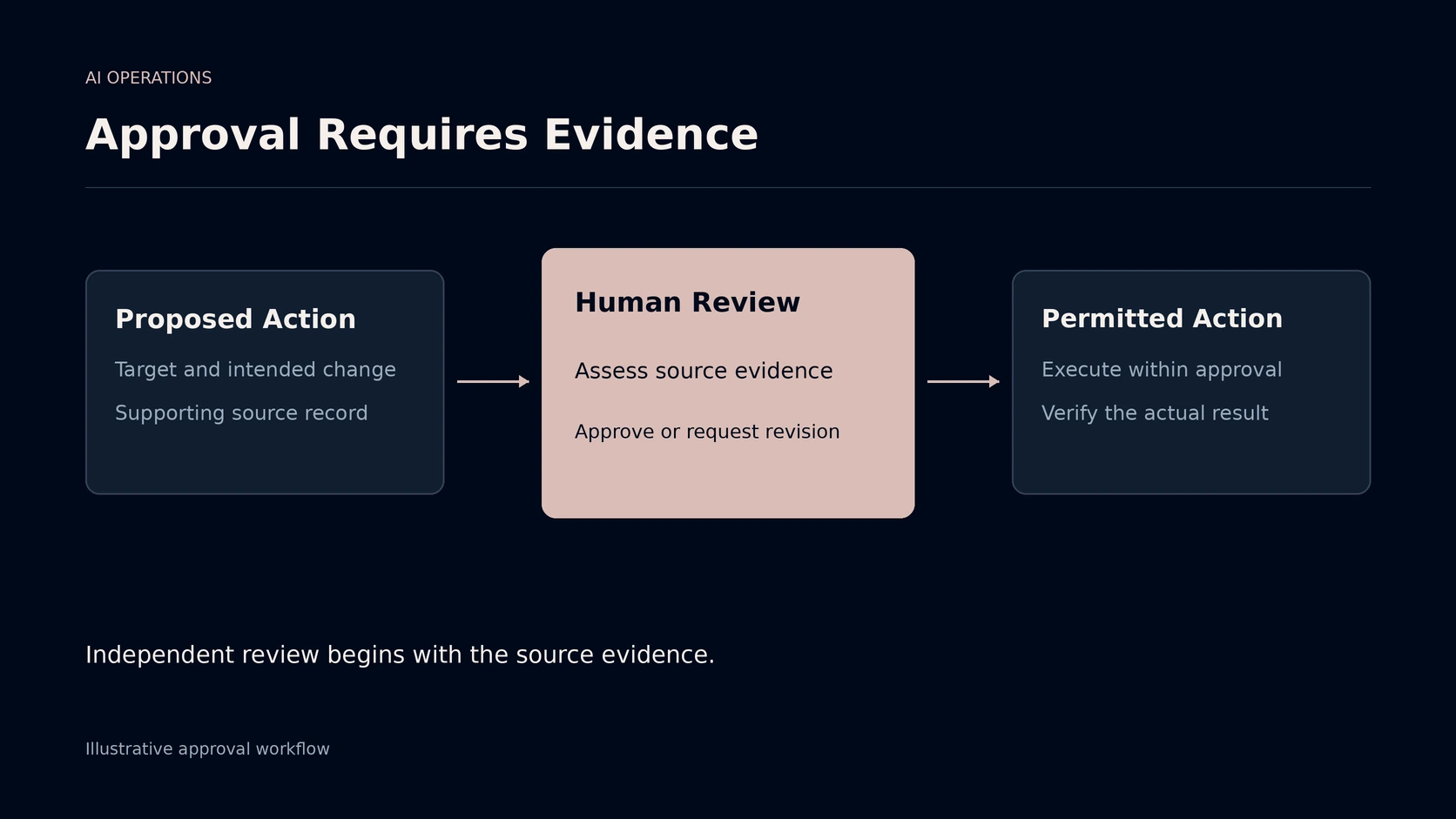
Preserve Evidence for an Actual Investigation
Incident investigators need to connect the customer's request with the attempted action so they can establish which instruction reached the application. Retain the authorization record alongside the application response recorded during execution. The relevant customer data needs a dated link to the proposed decision. For access permissions and retention, apply the company's applicable data-handling requirements. Within a long transcript, investigators need a direct route to the relevant operation.
For a disputed account change, the investigation needs the original state and the saved state after execution, linked to the operation's identifier. The approval record establishes which proposal the employee accepted. If the application later retries the request, investigators need evidence connecting the retry to the earlier attempt. Record an uncertain outcome as uncertain until the destination system supplies a verified result.
Reconcile Uncertain Outcomes Prior to Retrying
The operator responding to an interrupted connection needs to determine whether the destination accepted the action as a prerequisite for authorizing another attempt to make the same change. Sometimes the remote system completes an operation, and its response fails to reach the caller. The recovery procedure needs a supported way to inspect its outcome, followed by a retry method appropriate to the destination's documented behavior.
Stripe's retry documentation illustrates a specific mechanism for recognizing repeated requests through an idempotency identifier. Its documented behavior depends on the API version and the identifier's retention period. Treat such protection as a property requiring verification for the particular integration. Other connected applications need their own documented retry behavior and tests for interrupted execution.
Supplier discussions need an agreed route for obtaining incident evidence when an operation crosses a model provider and an application vendor. Specify which party investigates the disputed execution, with an escalation contact attached to the relevant service agreement. Counsel should examine the contract's allocation of loss against the intended deployment. The operating team needs access to the evidence necessary for an investigation while the contractual review proceeds. Commercial managers should check whether the planned support hours cover an interruption during the company's busiest customer period. If the agreement covers only office hours, budget an appropriate internal response for the remaining period.
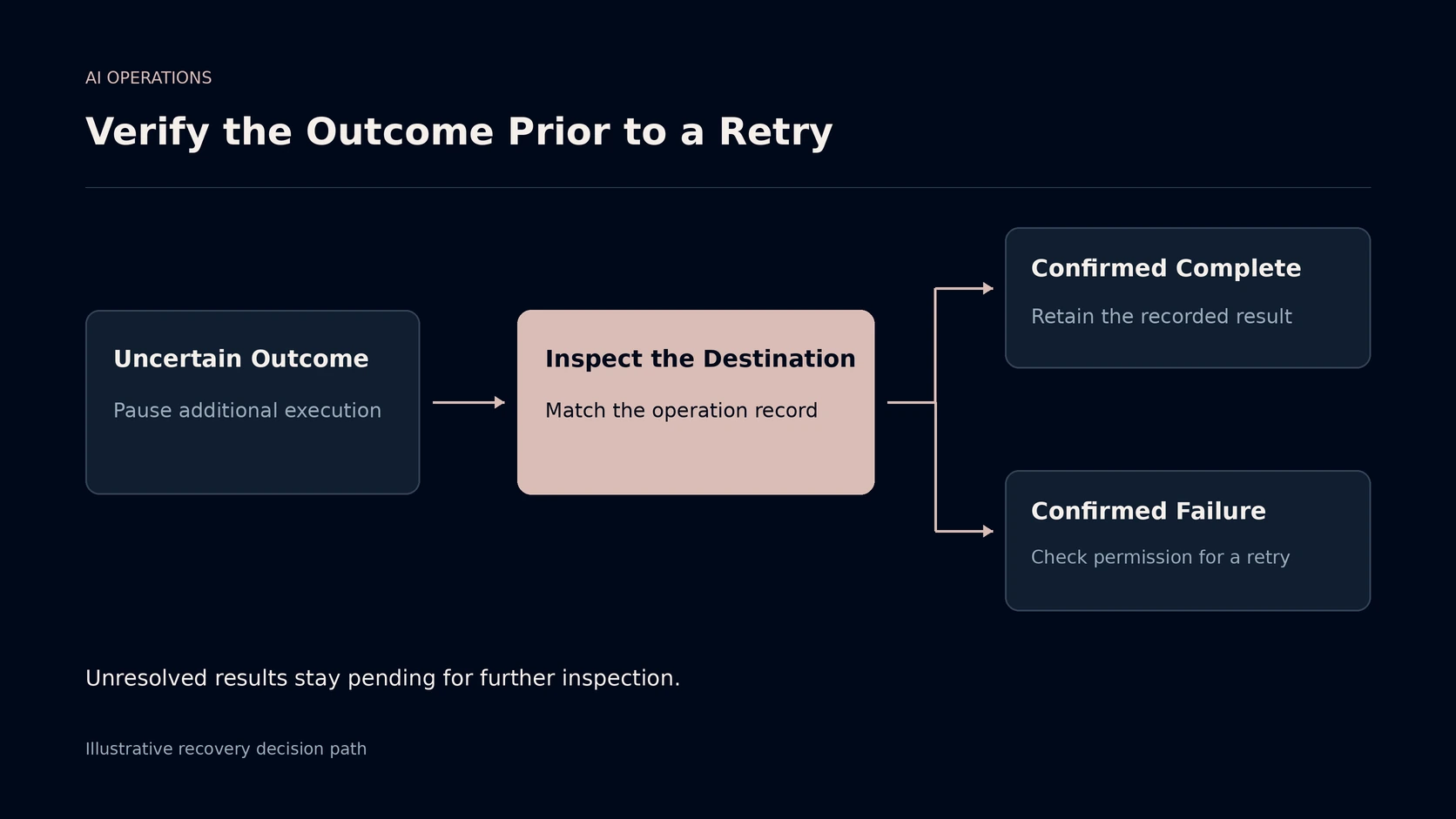
Fund Recovery Prior to Delegating Authority
The operations lead responsible for a live deployment needs a designated colleague to suspend affected automation while the team examines the incident's scope. NIST's framework recommends assigned authority to disengage problematic systems, alongside documented recovery arrangements. The business needs a workable fallback for customers waiting during the interruption. Use an unfinished customer case to test the fallback, then verify how ordinary processing resumes after repair.
OPERENDIA's backend engineering work addresses business permissions and application records, which are relevant when an AI proposal enters commercial operations. For recurring operating expense, see OPERENDIA's earlier examination of AI agent deployment costs. Discuss the proposed action authority with OPERENDIA, along with the recovery responsibility that the business intends to fund.
 Make your brand matter.