AI Agent Deployment Costs After the Pilot
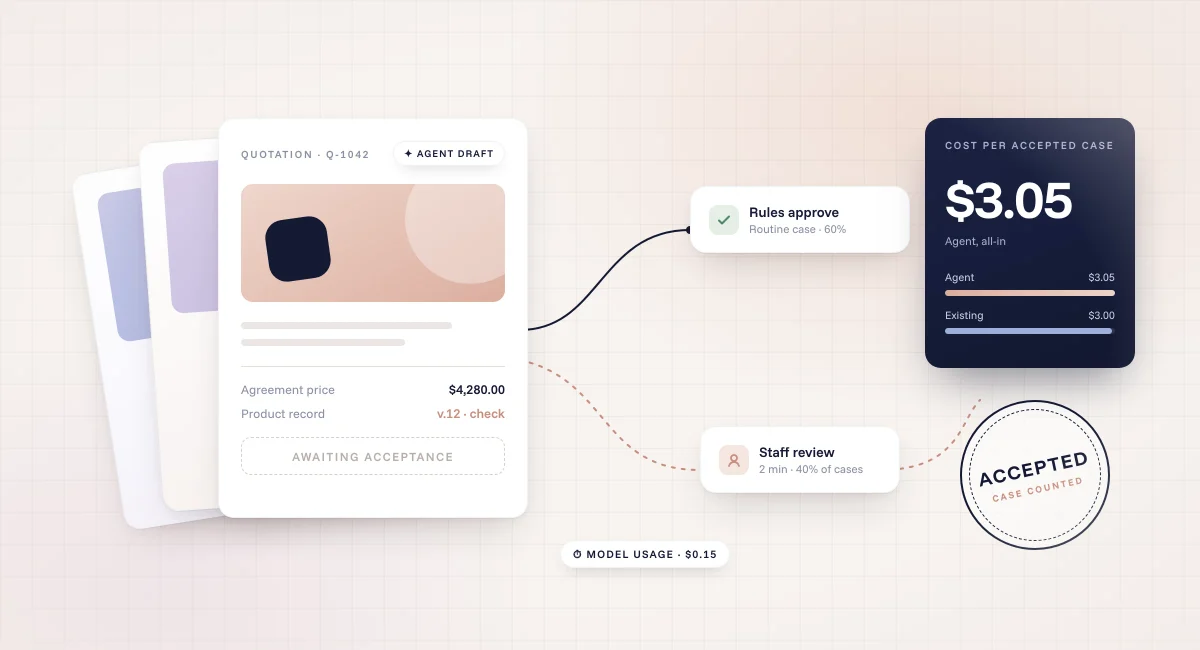
For an operations director watching an agent prepare a quotation, the financial question is how much employee time is saved on the next thousand requests. The time the work employees perform after the agent finishes, as the demonstration may leave that effort outside its measured run. When a quotation uses an outdated product record, an employee has to investigate the discrepancy against the approved pricing rules. The purchase estimate must include those minutes.
In McKinsey's August 2026 survey, approximately one in five respondents reported that their organizations' AI use was limited due to operating costs. Responses concern AI broadly and describe participants' own assessments. For a buyer evaluating a particular agent, the useful calculation starts closer to the actual work: total expense divided by completed cases that meet the company's acceptance criteria.
Count the Work the Business Accepts
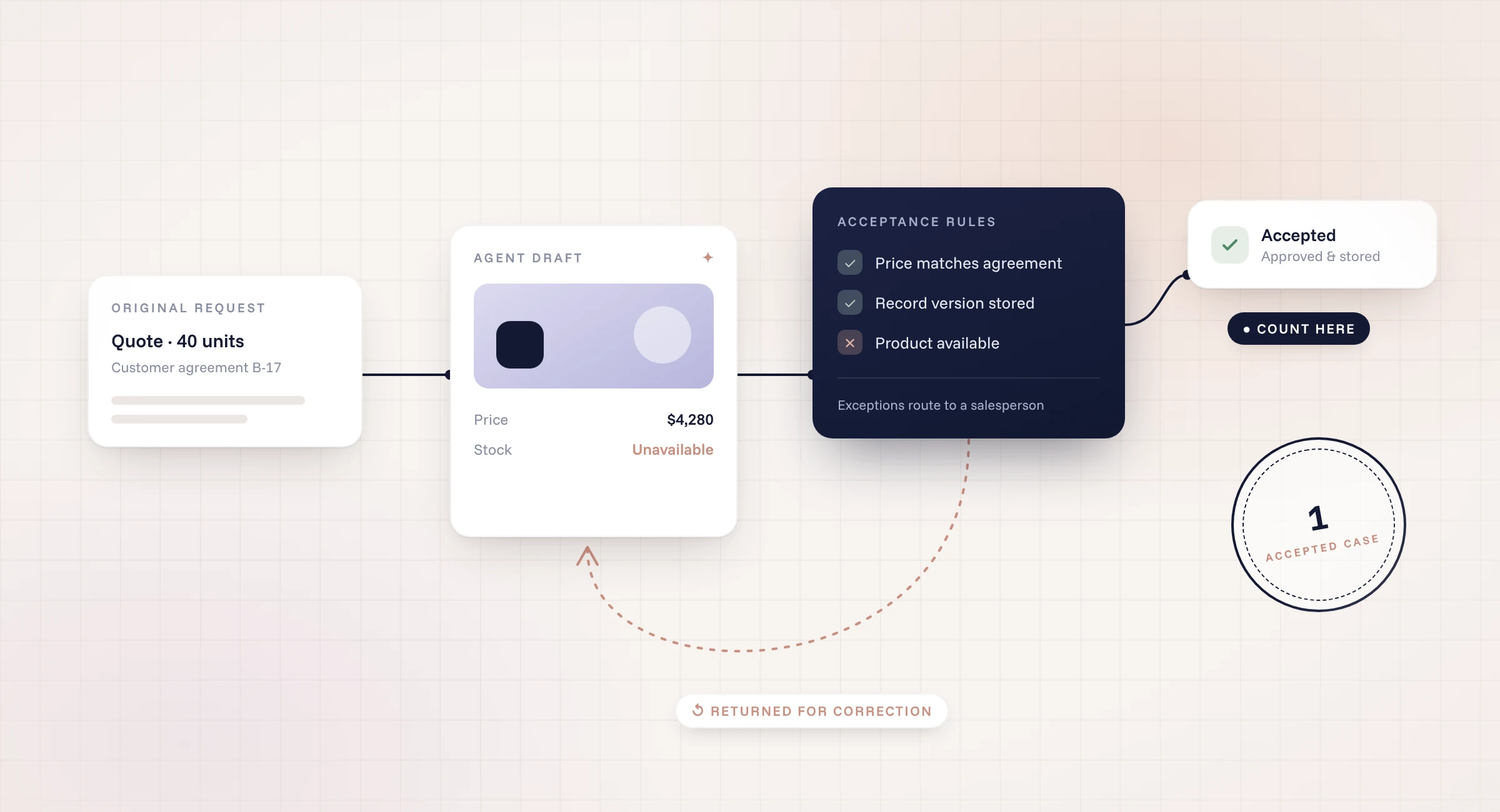
The sales system’s acceptance rules determine which quotations are included in this calculation, with routine approvals handled by the software and exceptions routed to a salesperson. If the requested product is unavailable, the draft returns for correction even when its price is accurate. Count the case after approval and record storage, so the cost estimate includes any work between the agent’s draft and an accepted quotation.
Compare the proposed agent with the existing method using the same original requests, and record the human handling time required to finish the work. Separately, examine cases the system sends back to employees for a complete restart. If the test includes only familiar requests with complete records, the resulting cost estimate applies to that narrow workload. Use the actual request mix when estimating a broader deployment.
The Review Queue Has a Payroll Cost
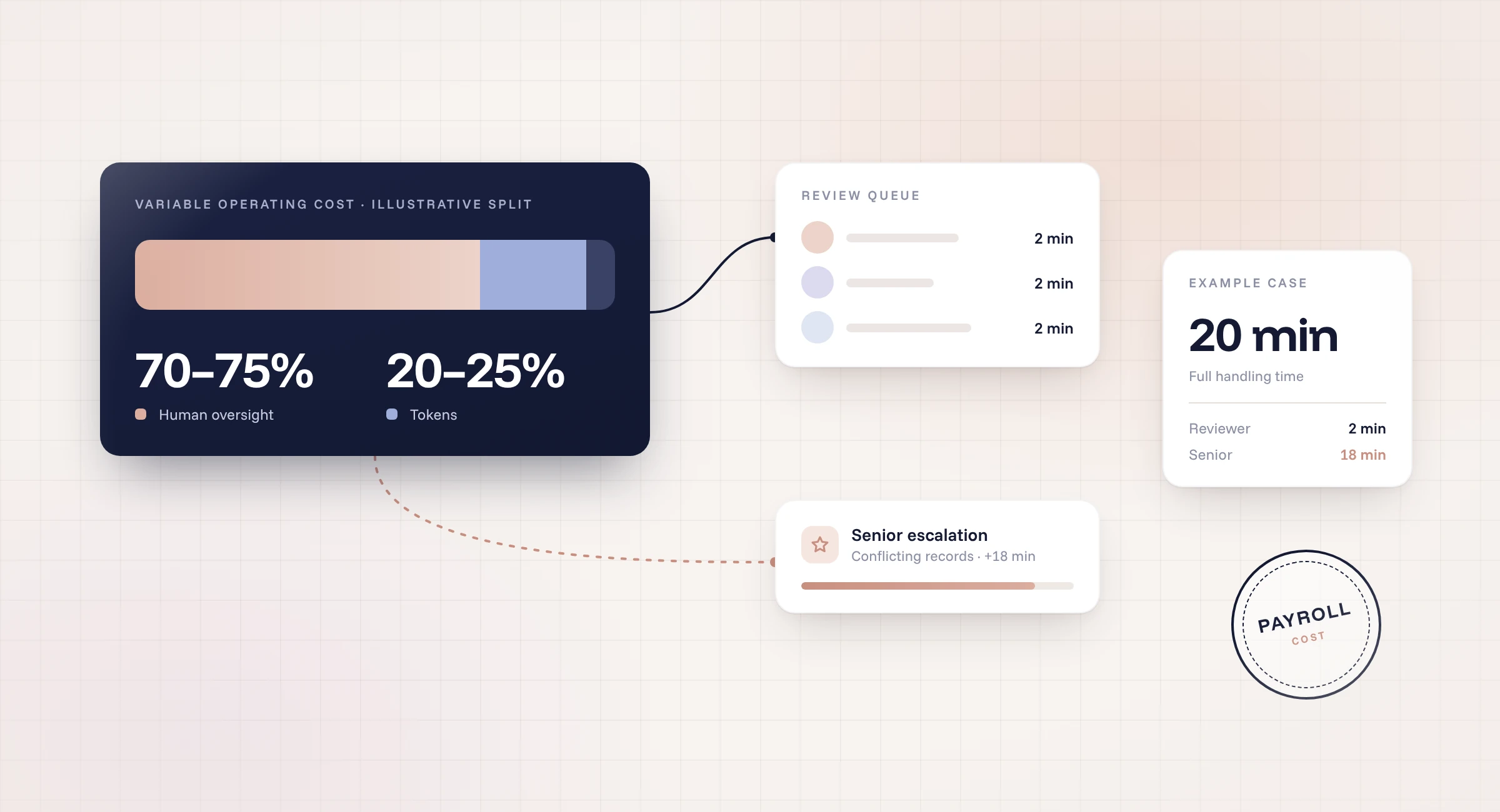
McKinsey's August 24 analysis assigns human oversight 70–75% of variable operating costs in its banking customer-service example, compared with 20–25% for tokens. Actual handling times from the buyer’s own pilot establish the applicable review expense; the consultancy’s banking ratios describe a specific commercial setting.
Suppose the commercial team checks every draft against a separate pricing file and then corrects the customer record before approval. The employee has become an operator for two systems. Faster draft generation saves little when verification requires repeating the original research. Write the review requirements into the implementation contract: show the evidence alongside the proposed quotation, and retain the record version used to calculate it.
Specialist review has a different labor cost when an exception reaches someone whose usual work carries a higher hourly expense. Measure the time a senior employee spends investigating conflicting records in the pilot. After the initial reviewer’s two minutes, a senior colleague may spend substantially longer on the same case. Record that additional work against the same case, so a departmental transfer preserves the full expense.
Integration Work Continues After the Connection Works
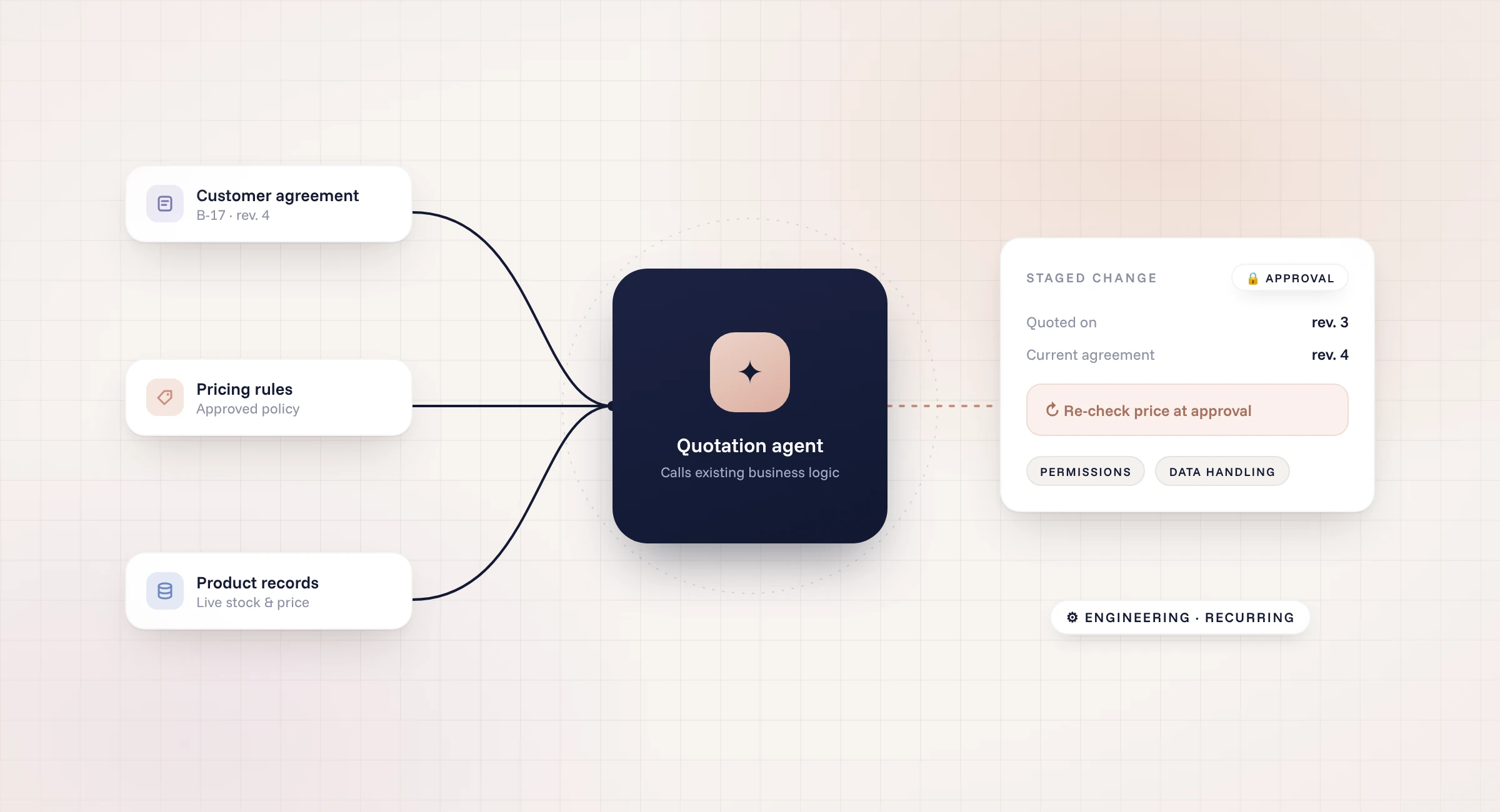
In its September 2026 commerce guide, Anthropic recommends connecting agent tools to existing business logic, with transaction restrictions enforced in application code. Proposed changes are staged for approval in the described implementation. To estimate the financial impact of a particular deployment, measure the labor required to operate the mechanism.
Customer-specific agreements determine the prices available to a quotation agent, so the integration must retrieve the applicable agreement alongside the standard product lookup. Where company policy requires prices to be checked again at approval, quotations prepared against an earlier agreement require an additional validation. Engineers must test that behavior against the agreed policy. The cost estimate rises when the company's existing software exposes insufficient information for those checks.
Security work has recurring staffing implications after launch, particularly when an employee takes on a different role or a supplier revises its connection method. Access must be tested against the permissions attached to the actual user. The price of testing is alongside the engineering work required when a connection changes. Company records passing through a model provider require an approved data-handling arrangement for that deployment.
Annual Cost in a Quotation Operation
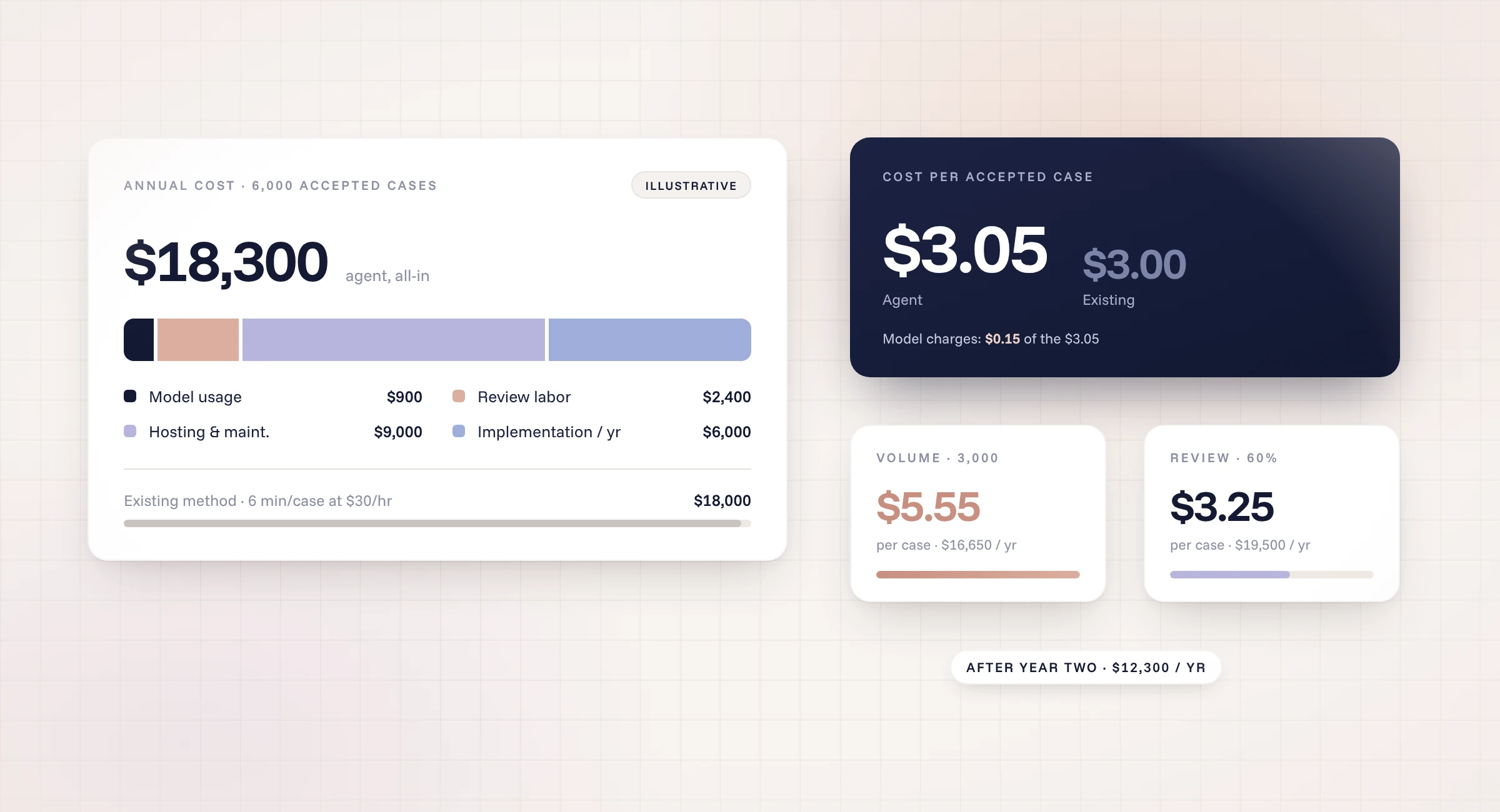
For a purely illustrative quotation operation, assume 6,000 accepted cases per year and six employee minutes per case using the existing method. The annual expense reaches $18,000 at a fully loaded labor rate of $30 per hour. Both methods are assumed to produce equal output quality in this invented budgeting example.
Suppose the proposed agent costs $0.15 per case for model usage after all repeated attempts needed to complete the work. Human review takes two minutes on 40% of cases; software rules approve the remaining routine cases. Across the annual workload, model charges total $900, and review labor totals $2,400. For hosting and maintenance, assume an annual expense of $9,000. Spread a $12,000 implementation budget across two years, and another $6,000 enters the annual comparison.
Together, the assumed expenses total $18,300 per year, so the company pays $3.05 per accepted case, compared with $3.00 under the existing method. Fifteen cents covers the model charges; the purchase decision concerns the full $3.05. Annual operating expense after the implementation allocation expires falls to $12,300 if the workload and maintenance budget remain unchanged.
If annual volume falls to 3,000 cases and hosting and maintenance still cost $9,000, the fixed allocation remains $15,000 in this illustration. Model charges and review labor fall together to $1,650. For the 3,000 accepted cases, $16,650 yields a $5.55 unit cost, compared with the existing method’s $3.00 assumption. Use the actual payment date in the financing plan; the two-year implementation allocation is a comparison convention.
Review coverage changes the calculation even when the agent’s model charges remain constant across the same 6,000 annual cases. If employees inspect 60% of cases at two minutes apiece, annual review labor costs reach $3,600. Add the remaining expenses, and the annual total reaches $19,500, or $3.25 per case. The additional $1,200 comes entirely from employees’ time.
Budget for Behavior Changes
Whenever a software change alters the behavior customers or employees receive in a real transaction, the operating budget must cover the necessary testing. Anthropic's January 2026 evaluation guidance distinguishes between an agent's reported success and the resulting system state, and recommends repeated trials to examine variation in outcomes. Test execution consumes resources, and people spend time deciding whether the recorded outcome deserves approval.
After a change to the quotation policy, the test case compares the final saved amount with the approved calculation for the customer agreement used in that case. The same release may affect an older customer agreement, so retaining earlier cases makes regression visible. Failed trials require diagnosis and another test run after repair. Allocate engineering capacity for that work in the maintenance proposal, with the agreed test coverage stated in ordinary business terms.
In its August 2026 forecast, Gartner predicts inference costs per agentic workflow will rise more than fivefold through 2028 as applications become more complex. For a long-running task, specify when the application pauses for review and how the operator resumes a partially completed case. Expenses accumulate during unsuccessful attempts, too, so a cost report restricted to completed runs leaves part of the bill unexplained.
Buy the Capacity the Company Will Use
After accounting for the full expense, the business case may rest on additional capacity during a busy period or faster service to customers. State the intended benefit in terms of what the operation that will be measured. Employees freed from quotation preparation might handle a larger existing backlog; the value depends on the work they actually complete. Payroll savings require an actual change in staffing expense.
OPERENDIA's approach to AI development places integration within the wider business operation, with customer-specific engineering assessed against the work the company intends to improve. Discuss a proposed deployment with OPERENDIA using the workload’s actual volumes and the expenses recorded in its pilot.
 Make your brand matter.