Who Gets to Decide What Your Brand Means?
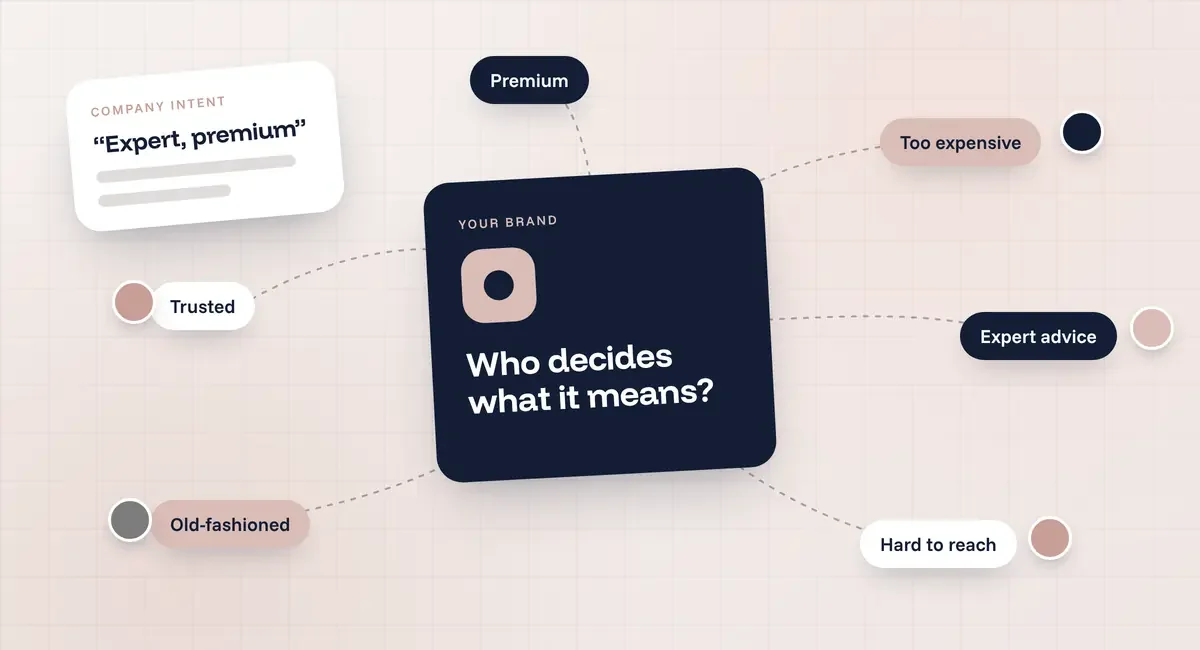
FC St. Pauli's supporters objected to a shopping broadcast from their own club in a dispute documented by a case study published in 2025. In comments on Instagram, fans criticized the promotion as a departure from the club's identity. What were they trying to protect when they objected to an attempt to sell merchandise?
For a business reviewing brand perception during a positioning change, customer interpretations create a commercial constraint whenever buyers regard those meanings as worth protecting. What management intends to communicate may collide with a reputation that customers believe they already know. When customers resist a change, their explanation may concern a promise they thought the business had already made.
Customers Participate in the Brand's Meaning
Published online in December 2024, the research examined FC St. Pauli through 26 interviews conducted between November 2021 and March 2022. The researchers used five internal documents and 36 media items. During their analysis, public comments documented disputes over branding decisions.
Since the researchers deliberately selected an unusual club, the account describes a specific setting that warrants cautious application to other businesses. Fans defended established meanings through public criticism. For the club's management, those objections exposed disagreement over which commercial activities fit the reputation supporters wanted to protect.
OPERENDIA's discussion concerning strategy and identity puts customer interpretation inside its branding philosophy and links that interpretation to business decisions. In research meetings, polished language can erase a buyer's actual objection if the team replaces it with an approved adjective. Keeping the customer's phrase preserves the disagreement as evidence for the pending positioning decision.
Familiar Names Carry Different Social Meanings
Consumers sometimes judge a brand through the people they associate with it, which makes the perceived user relevant to a positioning decision. In two studies published in 2005, Jennifer Escalas and James Bettman asked university students to identify social groups and related brands. After participants rated their connections to the named brands, the researchers compared responses across the group–brand combinations. Connection ratings were generally stronger when a brand fit the participant's own group and weaker when it fit a group the participant felt outside.
Using participant-generated brand information, the researchers measured psychological connections among students, whose responses require cautious application to buyers in other settings. Who does a prospective customer think the offer is for, and which phrase suggested that audience? Someone may admire a company's work and still classify its products as appropriate for a different buyer.
When professional terminology suggests an expert audience, someone evaluating a first purchase may infer that the product requires knowledge they have yet to acquire. Technical wording communicates specifications and signals the need for prior knowledge. If qualified beginners interpret the page as an offer reserved for specialists, a revision explaining the available support addresses a concrete question for testing. Answers from established users would leave the beginner's interpretation uncertain.
Follow the Connections Between Customer Associations
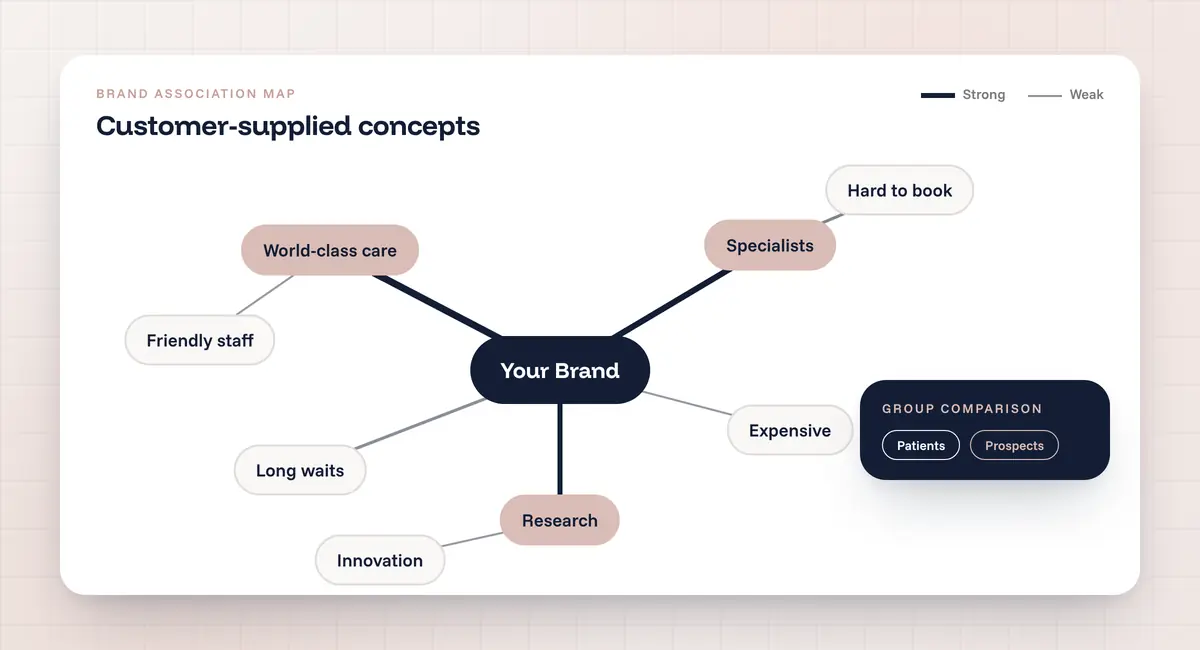
When buyers call an offer expensive, an association map can record which ideas they connect to its price and how strongly they link them. Introduced by Deborah Roedder John and colleagues in November 2006, Brand Concept Maps let participants connect their selected associations with lines indicating relationship strength. For the first study, 165 people mapped their associations with Mayo Clinic; 90 were current or former patients. The second study compared maps with a separate group's attribute ratings; association frequencies correlated .844 with average ratings across 23 brand associations.
During initial collection, researchers use open-ended responses so customers supply the concepts and wording that appear in the later mapping exercise. Individual maps retain disagreements between buyer groups for comparison after a consensus diagram compresses their responses. Where a buyer struggles to explain an association, the diagram provides little access to reasons that require a longer conversation.
Read the Reason Behind the Adjective
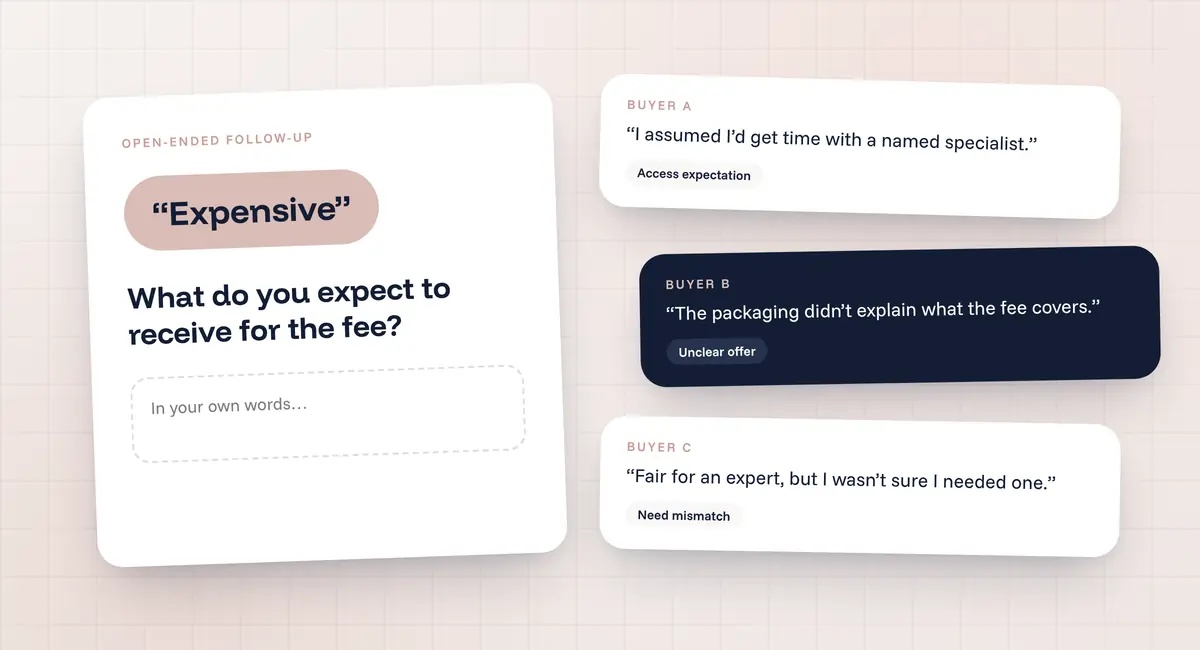
Pricing specialist work involves a judgment concerning which expertise buyers believe the fee covers and whether they expect access to a named professional. Ask buyers to explain in their own words what they expect to receive for the fee. For someone who anticipates access to a named specialist, evidence concerning that access bears on the purchase. Packaging may have suggested a different explanation to another buyer, whose objection concerns what the fee appears to cover.
When explanations point toward different investments, the original customer responses deserve comparison within buyer groups whose purchasing needs are genuinely similar. Purchase history affects who appears in a sample, so a difference between existing customers and prospects may stem from selection or information. For someone considering a first purchase, an advertisement may be the main evidence available. Comparing that answer with a customer's report following delivery requires attention to how they entered the study.
Recent Measurement Research Requires a Bounded Reading
Researchers who published an implicit-association study in May 2026 used January 2023 data from 514 toothpaste buyers in the United Kingdom. In a speeded task, participants judged how well recognized toothpaste brands fit specified attributes. Kantar's brand-level buyer counts supplied the outcome, recalculated as relative shares within the brand subset evaluated by a respondent. Within the statistical model, stronger associations accompanied higher relative buyer shares, and the relationship was stronger among respondents considering fewer brands. Testing purchase frequency produced limited evidence for the proposed interaction, which fell short of the authors' conventional statistical threshold.
Since the outcome came from brand-level buyer data, the participants' own purchases remained outside the study's observed results. Interpreting the study as an individual purchasing forecast would exceed its design. Pricing effects require separate evidence, and the paper treats implicit measures as an addition to other brand research. Which buyer-level transactions did a research supplier use to check its purchasing forecast?
Researchers evaluating the same company in different languages face an additional design decision when a translated adjective suggests a different judgment. During translation, a change from criticism to praise can alter which brand problem the final report appears to describe. Preserve the original response beside the translation. If a bilingual reviewer considers two readings plausible, the disagreement belongs in the report.
Decide Which Interpretation Deserves a Response
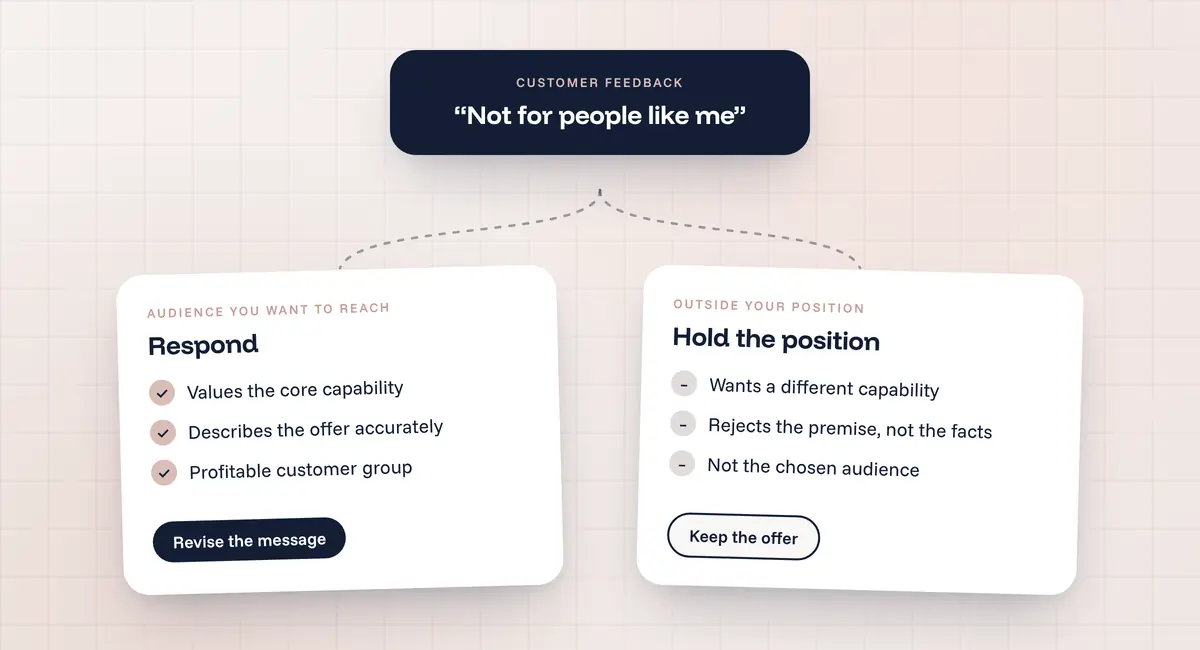
Public disagreement deserves a commercial decision when the people expressing it belong to an audience the business genuinely wants to reach. If a specialist product addresses buyers who value a particular capability, resistance from a different audience may fit the company's chosen position. What offer does the respondent believe is available, and how does that account compare with the actual terms? If respondents accurately describe the offer and reject its premise, management faces a choice concerning whom the product should attract.
Connect Credibility to a Specific Claim
Describing a business as an expert leaves a question concerning the work buyers actually trust it to perform and the evidence supporting that judgment. Confidence in advice may concern diagnosis, even when the offer being sold requires successful implementation. During the interview, a specific qualification or completed assignment supplies something the buyer can assess against the company's claim.
Positive customer descriptions can contain an unexpected commercial opportunity when buyers value a benefit that management treats as secondary. Ask which buying need that benefit satisfies, then check whether the business can support it at the proposed price. If the benefit belongs to a profitable customer group, a revised message would propose a different reason to buy the existing offer. Which existing product evidence supports the benefit that those buyers value?
OPERENDIA's brand strategy work includes customer perception research alongside positioning decisions, so a useful brief begins with the interpretation that management needs to investigate. If buyers expect access to a named specialist at the existing price, the proposed promise needs a delivery-cost estimate for that level of access.
 Make your brand matter.