Cheap AI Content and Expensive Human Approval
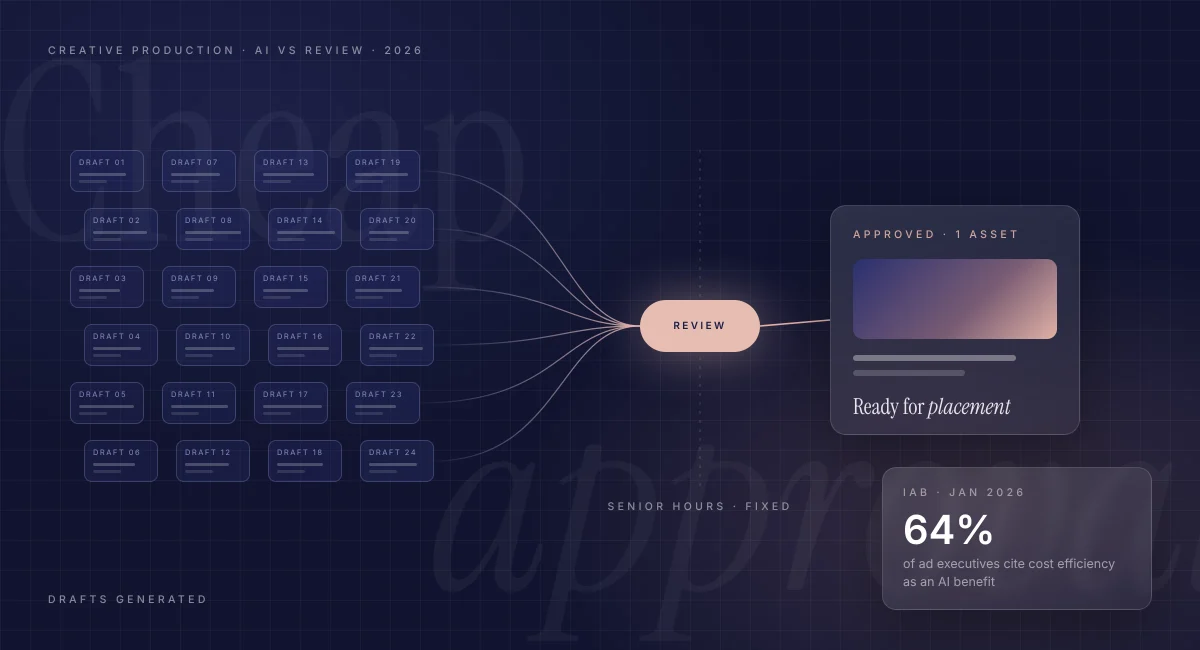
The creative director who approves AI-generated advertisements needs a production budget which includes the work required to get usable material into a campaign. Quoted software fees cover generation. Less visible is the senior editor's afternoon spent repairing product claims or explaining why a technically competent image misreads the brief. AI content costs belong in the campaign budget alongside human approval, with the final creative assessed against its commercial purpose.
In IAB's January 2026 research, 64% of surveyed advertising executives cited cost efficiency as an AI benefit, their most frequently selected advantage. The study surveyed 104 US industry executives and 505 US consumers from Gen Z and Millennial age groups. Treat the efficiency response as the executives' assessment, with realized savings measured in the company's own production accounts.
Price the Work Approved for Use
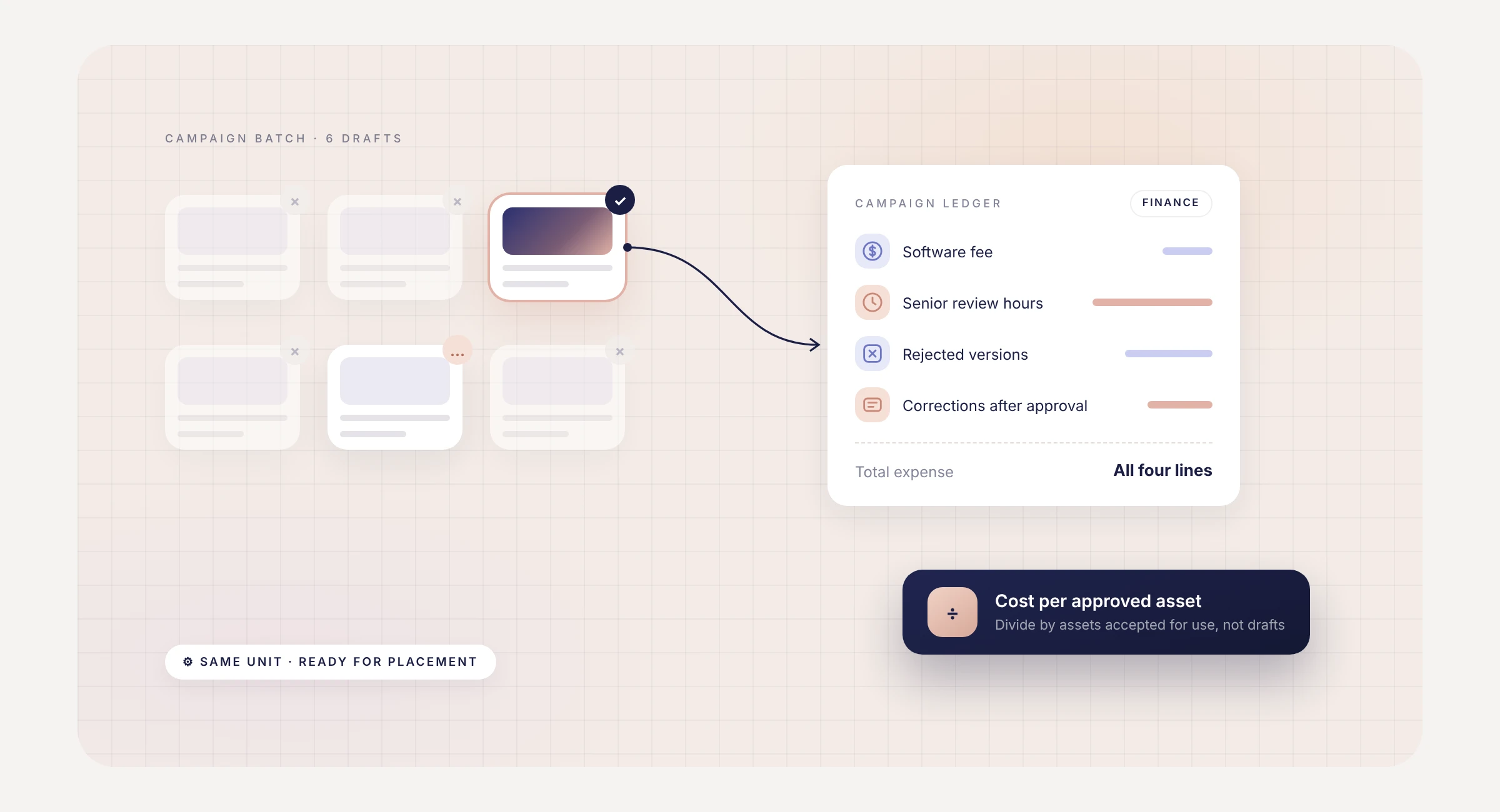
Finance teams comparing production methods need the same unit: an advertisement ready for its agreed placement after the required checks and revisions. Draft counts describe how much material a tool produced. For an approved video, add the software expense to the labor required throughout preparation and subsequent correction.
Reviewers who discard several versions still spend time on material commissioned for the campaign, so their inspection belongs in its expense account. After calculating total expense, divide it by the assets accepted for use. Content formats need separate accounts when their approval requirements differ: a revised product caption has a different workload from a film containing a new product demonstration. For resized exports, retain a separate count from genuinely different creative ideas.
Calculate the Review Allowance
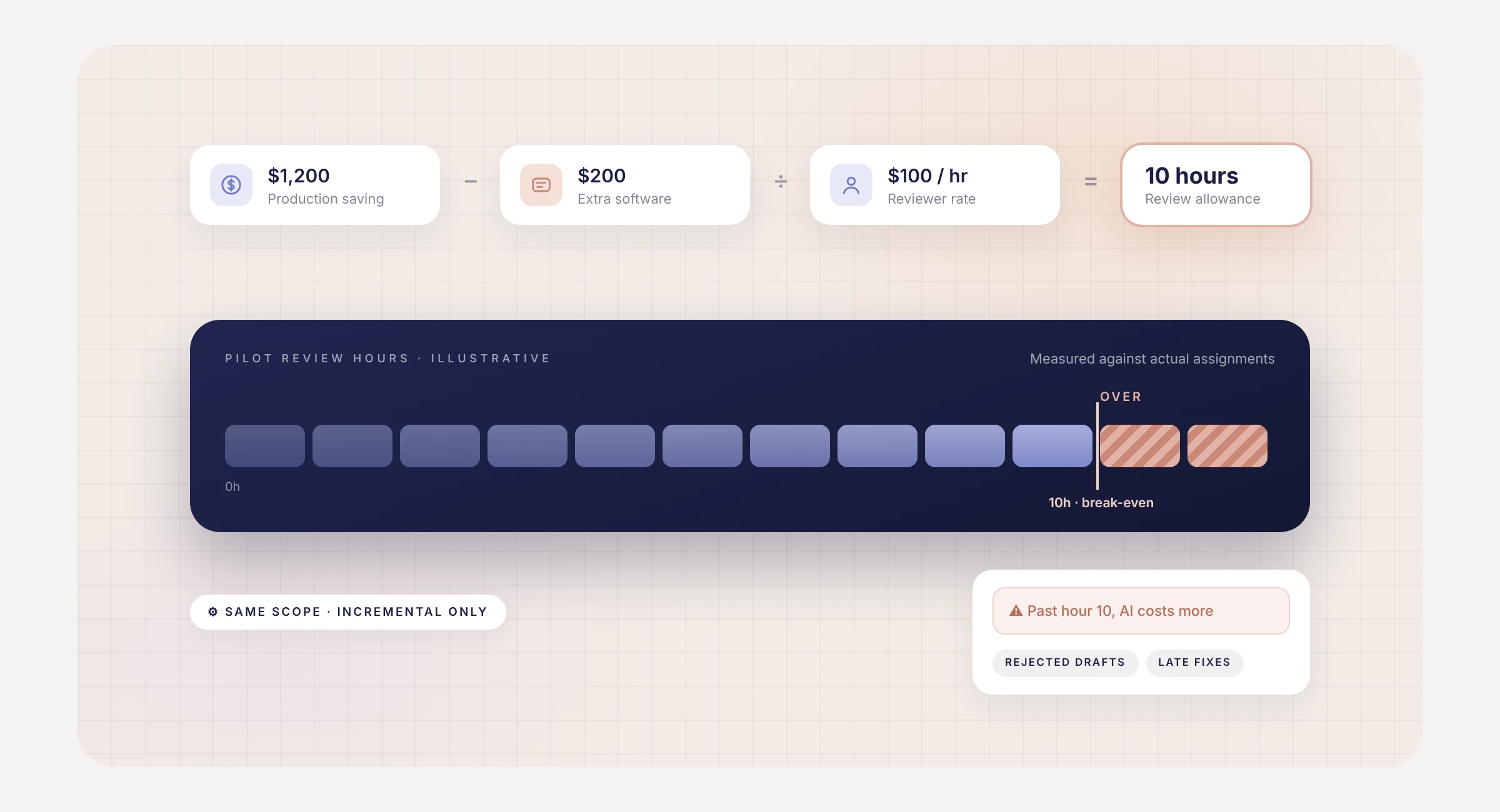
Suppose an illustrative campaign saves $1,200 in initial production expense through AI assistance, with the same finished scope expected from both methods. After an extra $200 in software charges, $1,000 remains available for additional review. If the assumed fully loaded reviewer rate is $100 per hour, ten extra hours consume the remaining saving. Both methods' ordinary review costs are assumed equal and excluded from this incremental comparison.
Pilot reviewers should record the additional hours against actual assignments so the comparison includes rejected versions and the final corrections after approval. Once the measured extra review exceeds ten hours in this illustration, AI assistance costs more for the agreed scope. Management may still approve a higher expense when the campaign gains stronger creative work. To justify the increase, assess the finished execution against the campaign objective.
Find Why the Draft Returns
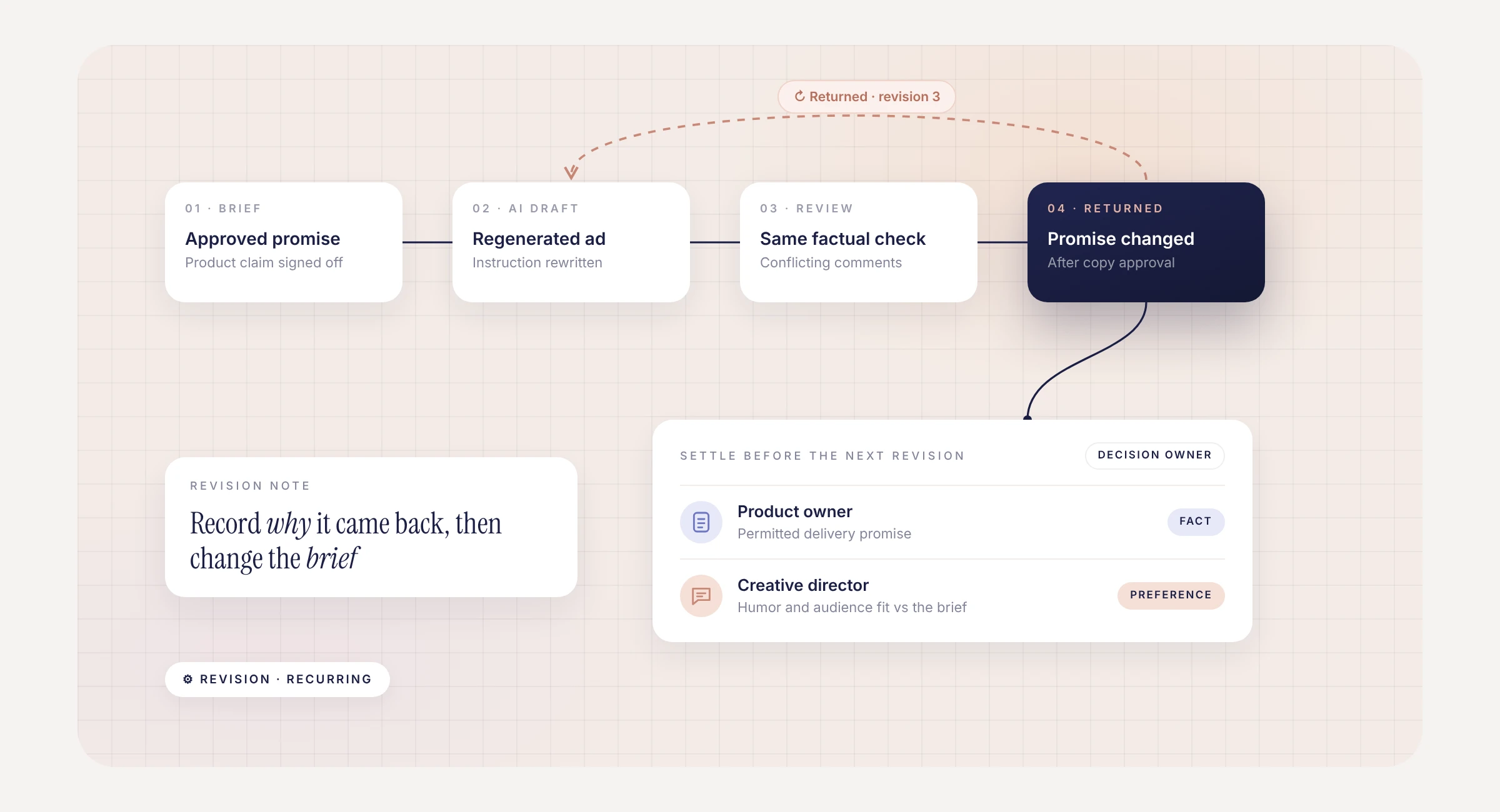
The reviewer whose desk receives repeated corrections needs to identify the recurring decision and the person who has authority to settle it. If the product team revises a delivery promise after copy approval, regenerated advertisements will require another factual check. The product owner needs to settle the permitted promise prior to the next revision. Until the commercial disagreement is resolved, another instruction rewrite will return the same question to the reviewer.
Creative directors need to separate factual corrections from personal preferences when several colleagues return conflicting comments on the same asset. Product accuracy belongs with someone who knows the current offer. For a proposed change in humor, the director needs to assess audience suitability against the approved creative idea. Record the reason for a substantial revision; repeated objections then provide evidence for changing the next brief.
Protect the Idea during Revisions
In its October 2026 strategy report summary, WARC discusses human judgment as a source of value for strategists as AI enters their work. The publication reports practitioners' views and discusses the questions worth pursuing. For a business commissioning content, the commercial decision starts with which customer belief the advertisement should address.
If the brief asks an advertisement to explain a product's repairability, an attractive lifestyle image may require rejection even when the rendering is technically clean. The proposed execution needs a credible product explanation. Judge proposed changes against the same brief so personal preferences remain separate from the assignment. OPERENDIA's earlier article on brand recognition in AI content examines the additional question concerning which company customers associate with the finished advertisement.
Editors need approved product evidence beside the creative files so they can check a revised claim against its actual basis during campaign production. When the advertised offer changes, identify the affected assets and commission the required edits. Editors must correct an obsolete claim throughout the variant library, with the associated labor charged to the revision.
Use Predictive Tests for Specific Decisions
In an August 2026 update, Kantar describes how its LINK AI assessment received holdout validation using more than 10,000 advertisements. The vendor reports comparable ratings between its predictions and human surveys for more than seven in ten digital video and television ads within the assessed channel and market. For a particular advertisement, interpret the forecast against the population and outcome it predicts.
Creative teams using a predictive score to request revisions need to identify the requested change and the evidence supporting the proposed edit. Kantar's separate guidance on AI-assisted creative assessment identifies local cultural references and indirect humor as areas requiring human interpretation. For a joke aimed at a particular community, someone familiar with the reference needs to judge the proposed execution. Budget for the relevant expertise alongside the assessment fee.
Keep the Purchase Outcome in View
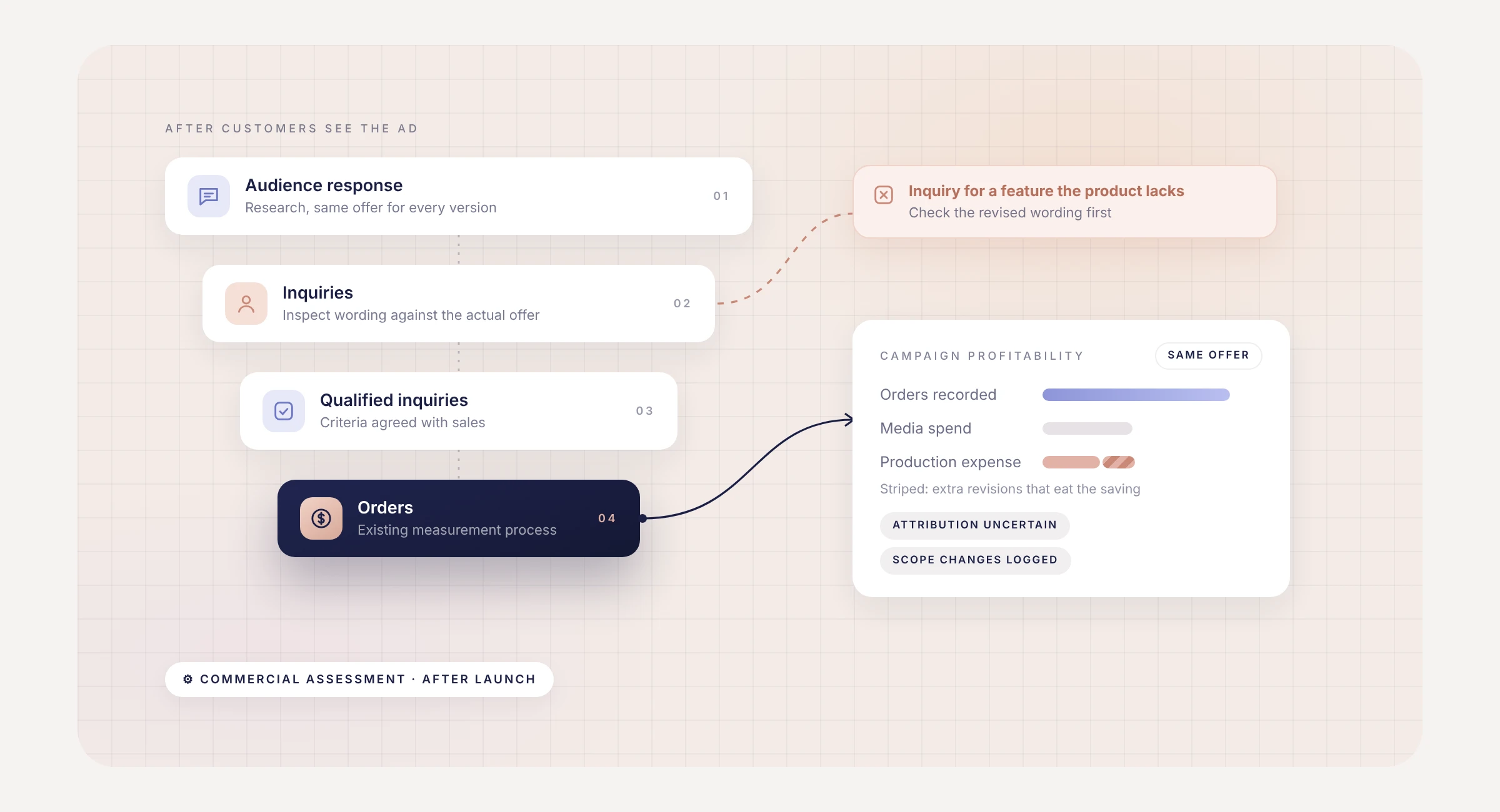
For a campaign seeking product sales, research into audience response needs a subsequent commercial assessment after customers encounter the advertisement. Compare creative versions against the same offer where the campaign design permits a credible comparison. Alongside media expenditure, include production expense in the profitability assessment. Apparent efficiency gains shrink when additional revisions consume the original production saving.
If a revised advertisement attracts inquiries for a feature the product lacks, inspect the wording against the actual offer and the sales team's questions. The campaign team and sales need agreed criteria for qualified inquiries. Record the resulting orders through the company's existing measurement process, with attribution uncertainty retained in the report. More generated variants warrant additional expenditure only when the campaign has a useful decision to test.
Managers comparing the pilot with ordinary production need equivalent starting briefs and final delivery requirements throughout the assessment to measure a genuine expense difference. Record extra work requested during the test as a scope change. Otherwise, the cost comparison charges one method for a larger assignment. When a supplier uses AI to create additional language versions, include the qualified language review required for those versions in the proposed fee. Extra content creates a commercial benefit only where the company has a funded plan to use it.
Buy Review Capacity alongside Production
Specialist reviewers need reserved capacity in the production schedule when a campaign deadline depends on their approval and the work has a fixed arrival date. Higher draft volume can lengthen the queue if the available review hours remain unchanged. Agree on a shortlist for detailed assessment, with the initial screen performed against the approved brief. The commercial team should commission enough variants to answer its research question within the available assessment budget.
Clients comparing agency proposals for AI-assisted production need to check how revisions enter the fee after changes to an already approved product claim. Internal disagreements have a labor cost regardless of who generates the replacement copy. If a supplier promises a lower creative fee, compare the client's expected review hours with the existing arrangement. The senior employee's additional workload belongs in the comparison.
Approve the Budget against the Customer Promise
OPERENDIA's art direction connects visual decisions with the buyer's interpretation and the commercial use planned for the finished work across a company's campaign materials. For an AI-assisted campaign, the brief needs an approved customer promise alongside a realistic allowance for revisions. Price the people required to judge the execution, then compare the finished campaign's expense with the outcome the business plans to measure. How much senior review can the next batch absorb at its proposed fee?
 Make your brand matter.