Next.js and Laravel Architecture for Commercial Web Applications

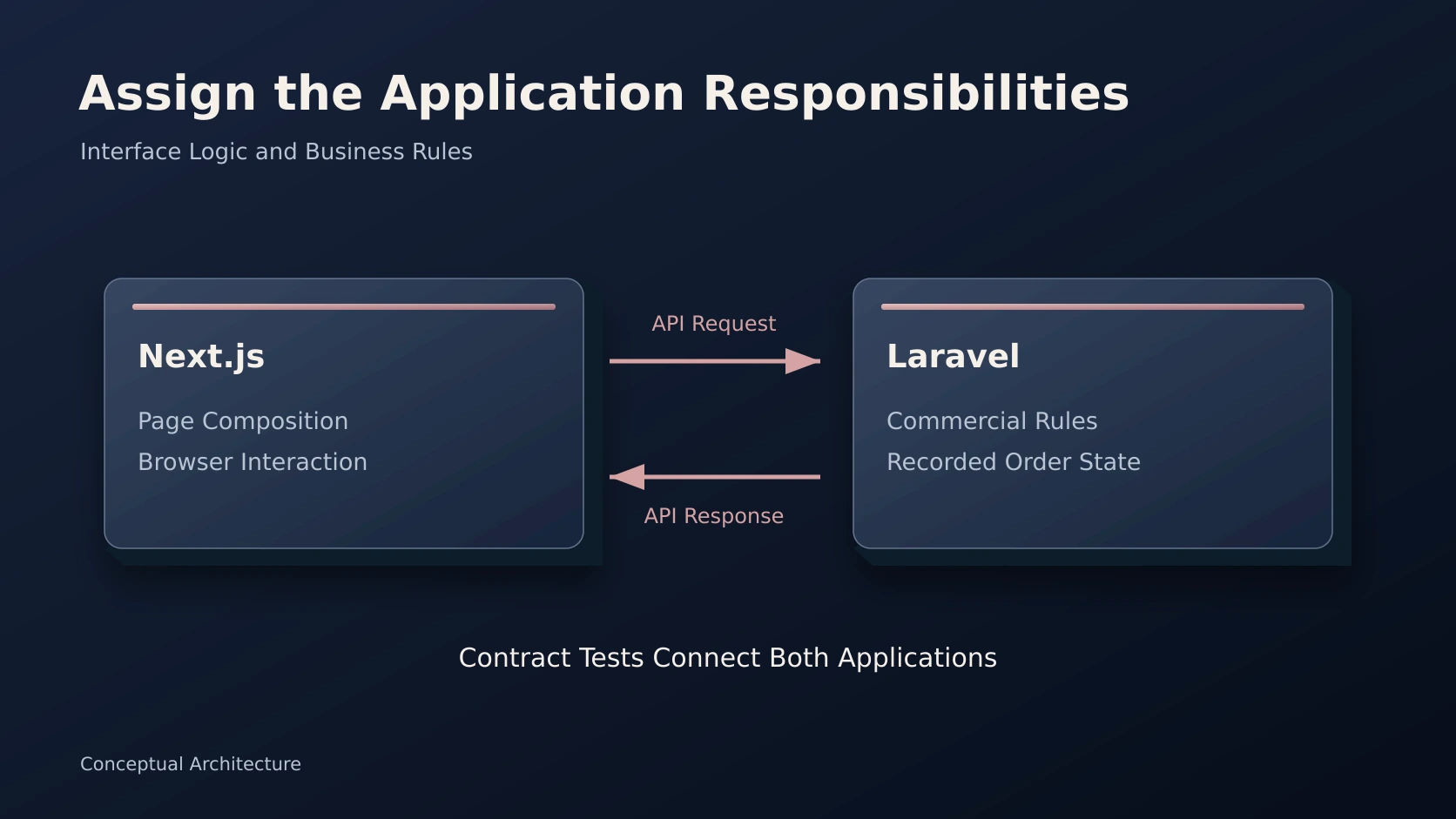
Next.js and Laravel suit commercial applications whose customer interface changes frequently and whose business rules need a consistent home across web and mobile clients. In this architecture, Next.js handles page composition and browser interaction; Laravel evaluates requests against the business's rules and records accepted changes. The useful decision concerns where a transaction becomes authoritative, particularly when the customer sees a confirmation several seconds ahead of a delayed external response.
For a business commissioning a custom application, the architecture proposal needs to explain how an order travels from the interface to a durable record. Alongside page appearance, the proposal needs to describe API behavior. Customers encounter both through the same purchase, so the displayed status must agree with the business's actual ability to fulfill it. For applications with distinct responsibilities or release needs, the additional operating cost may be justified.
Assign the Interface and Business Responsibilities
Next.js supplies React-based page composition with distinct execution environments for content retrieval and interactive controls, as its component documentation explains. In the App Router, layouts and pages execute within the Next.js runtime by default. Browser state and event handlers belong in client components. For an order page, that division permits initial content retrieval during page generation and quantity changes inside an interactive control.
Laravel becomes the business API when commercial rules need to remain consistent across several clients and administrative tools that operate on shared records. Inside that boundary, an order service calculates the accepted price and evaluates the requested status change. Customers may adjust quantities in the browser, but the submitted request still passes backend validation. Administrative corrections require the same business rules, with additional permissions for the staff member's actual role.
Decide Where Next.js Calls Laravel
Next.js offers public HTTP endpoints through Route Handlers, which makes an interface-specific API layer available when the application needs one. Its backend guidance recommends direct data retrieval during page generation instead of a round trip through the application's own Route Handler. In a Laravel architecture, the direct destination is the business API. Use an intermediary endpoint when browser requests require response composition or a protected integration, with an explicit reason for the extra hop.
Design an API Contract Around Commercial Actions
Order endpoints need a written request contract that describes accepted fields and the response returned after the application evaluates the transaction. For money, specify currency alongside the amount's storage convention. Dates require an agreed time-zone convention. In Laravel's API resources, developers select which model attributes appear in JSON responses, so the customer-facing contract stays separate from the database's internal layout.
The frontend team needs examples for rejected requests within the contract, particularly when a customer must change a field or refresh availability. If the requested quantity exceeds stock, the response should identify the relevant field and the reason for rejection. Alongside the customer explanation, an application-readable error identifier lets the interface choose the correct recovery behavior. Contract tests compare real API responses with the frontend's expectations during development.
Choose Authentication for the Actual Domain Arrangement
Laravel Sanctum supports cookie-based authentication for first-party browser applications, with deployment requirements that belong in the architecture proposal at the outset. For this mode, the Sanctum documentation requires the browser application and API to share the same top-level domain; separate subdomains are permitted. The configuration identifies trusted first-party domains and permits credentialed requests through the appropriate cross-origin settings.
For this session-based arrangement, the browser first requests the CSRF cookie and then submits the login request to Laravel's authentication endpoint. Subsequent protected requests carry the session cookie together with the required CSRF header when applicable. If Next.js retrieves authenticated data during page generation, developers must specify how the incoming session reaches Laravel. Cookies require deliberate forwarding and scope checks across the boundary between application runtimes.
Enforce Permission at the Requested Record
Authentication establishes the user's identity, and the requested commercial action still needs a permission decision tied to its target record and current state. In Laravel, policies organize authorization around a model or resource. Next.js recommends authorization checks close to data access. For an order amendment, the backend evaluates the authenticated account's relationship to that order; interface visibility remains a separate presentation decision.

Keep Database Changes Within a Transaction
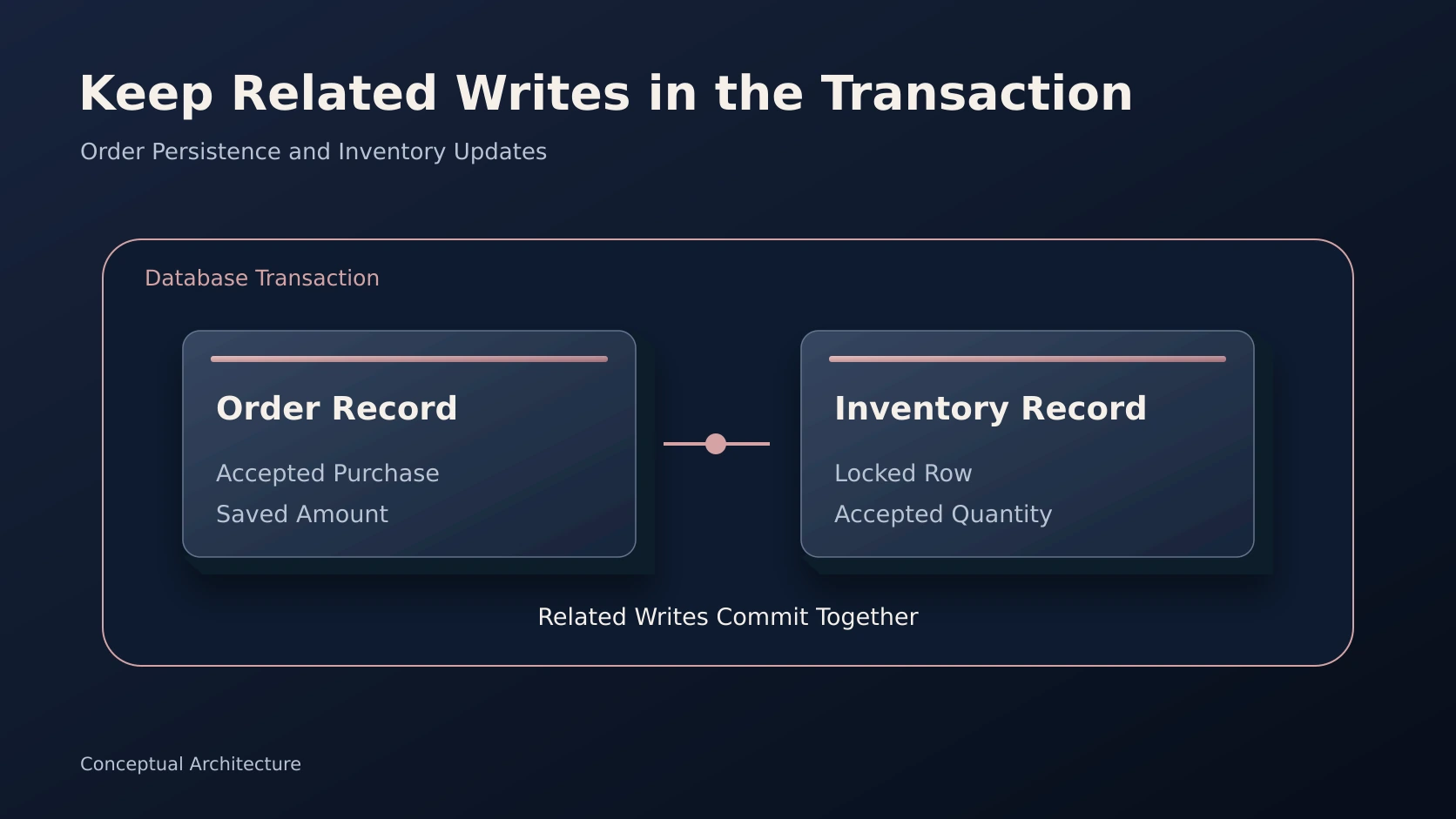
Laravel's database transaction support belongs around related writes that must succeed together, such as an order record and the corresponding inventory adjustment. If the transaction's operation raises an exception, Laravel rolls back its database changes; successful execution commits them through the behavior described in its database documentation. The boundary covers the participating database operations. For an external payment provider's state, the application needs a separate integration design.
Concurrent purchase requests need a database strategy for the moment when both customers request the same remaining inventory during overlapping execution. Among its documented concurrency options, Laravel provides a lock for update through its pessimistic lock support. For an inventory record, the application locks the relevant row and checks availability inside that transaction. Keep the locked operation short; a remote provider request introduces an external delay while competing database work waits.
Treat Payment Confirmation as an External Event
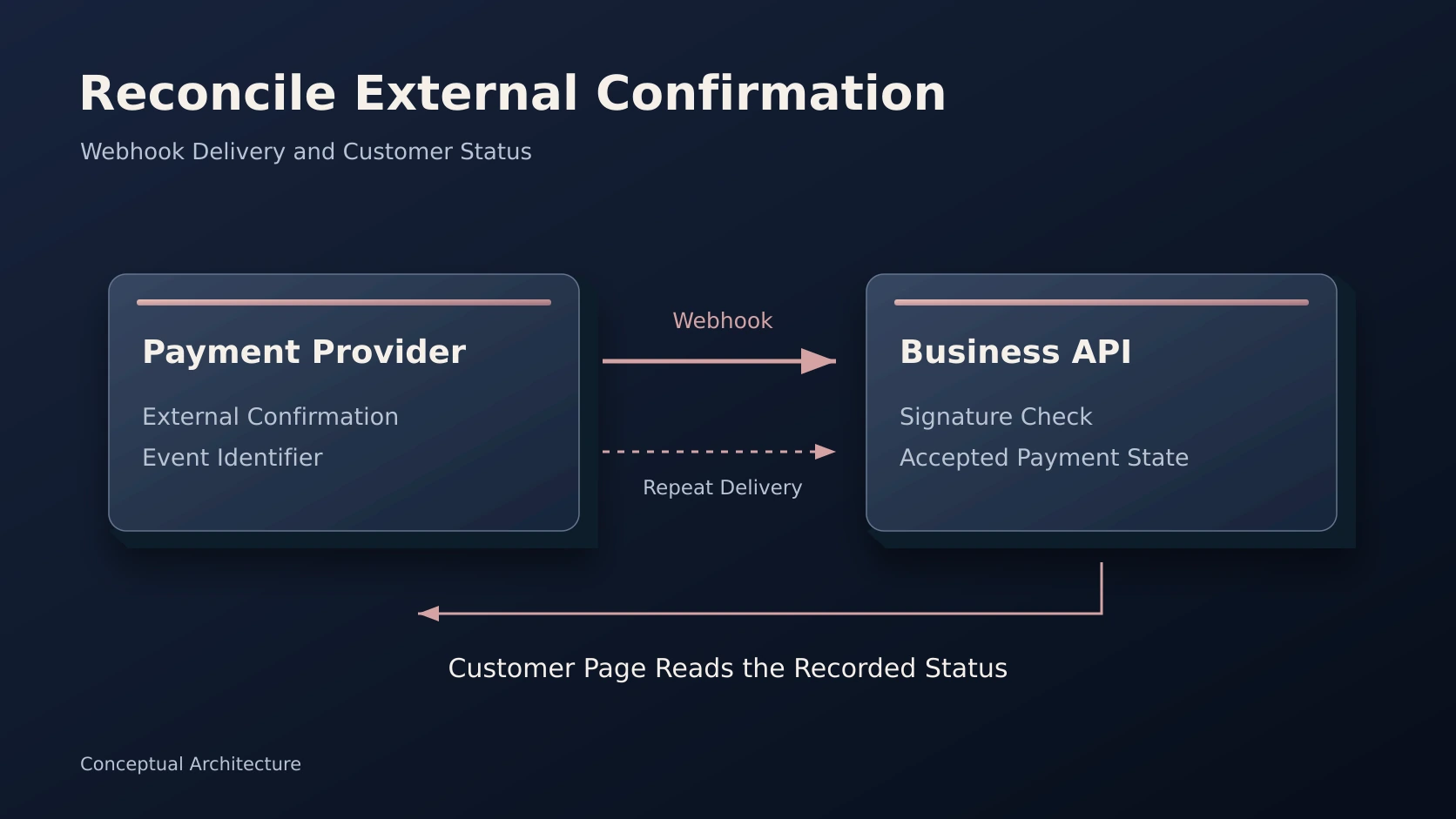
The customer-facing return page needs to display the backend's recorded payment state, with a pending status available during delayed provider confirmation. In Stripe's webhook guidance, event delivery may repeat and arrive outside creation order. The receiving endpoint verifies the provider's signature and records enough event identity to recognize repeat delivery. Once the payment state permits fulfillment, the application executes the corresponding transition.
Retry behavior belongs in the transaction specification so a repeated customer request retains its original commercial meaning after a timeout or interrupted connection. For order creation, reuse the request's application identifier and return the existing outcome when processing has already succeeded. Acceptance tests need repeated submissions, with the resulting order count checked against the intended purchase. Once provider confirmation arrives, inspect the status displayed after the customer returns to the application.
Separate Background Work from the Customer Response
Laravel queues provide a place for work such as confirmation messages after the application has recorded the order and returned a response. To delay dispatch until related records exist, configure the behavior described in its queue documentation. When the transaction rolls back, jobs scheduled through that configuration are discarded. Developers still need a recovery design for failed jobs and durable entries for pending external work.
The deployment plan needs to name the person responsible for investigating a failed background job and authorizing its retry against an existing order. For customer reports, retain request identifiers in application logs so staff can trace the relevant API exchange. When an incident occurs, support staff need the recorded transaction state and an approved correction path. Repeat external actions require the same duplicate protection as the original request.
Match Cached Content to Its Commercial Use
Public product descriptions and a customer's current order status need different freshness decisions, since a delayed status update changes the meaning conveyed by the page. For data whose stored responses need to be replaced, Next.js documents cache refresh mechanisms. Specify which content tolerates a delay and which requests read current backend state. Personalized order data requires an account-specific access path, with cache behavior examined during permission tests.
After an accepted order amendment, the browser needs a response that states the persisted result and updates the relevant visible content. If an older response remains cached, the customer may see a quantity that differs from the saved record. Test the page after a write and after a fresh visit. Isolation tests add a second authenticated account to the same sequence.
Commission the Boundary Alongside the Interface
OPERENDIA's backend development work focuses on the business services that support customer-facing applications, with architectural decisions tied to the actual commercial workflow. For a Next.js and Laravel project, the proposal needs an agreed API contract and evidence for permission checks. Acceptance testing then examines the complete customer action through the persisted result. When a transaction remains pending or requires correction, the interface must communicate the recorded state in language the customer understands.
When backend and frontend releases occur on separate schedules, the API must accept requests from versions already open in customers' browsers. Compatible API changes permit those requests to continue during deployment. For a breaking contract revision, specify the transition period and the affected clients. The project handover requires a named maintainer for both applications, responsible for testing their interaction after changes to either application.
 Make your brand matter.