Custom Software vs SaaS: How to Choose the Right Business System

Custom software becomes a credible choice when a company's commercial rules require behavior that purchased applications handle poorly, especially across customer transactions and employee permissions. For familiar work with a proven product fit, SaaS often provides an accessible route to deployment. The decision starts with what the business needs its software to do, followed by evidence that the proposed system supports that work at an acceptable ownership cost.
Commercial software applies decisions that customers encounter during a purchase, from the availability displayed on a website to the permissions attached to a supplier's account. Once a reservation changes after payment, the application must reconcile the revised order with the customer's existing transaction. Rules like these deserve attention early in a software decision, since the interface alone leaves required behavior outside the visible screen.

What Custom Software and SaaS Actually Change
SaaS provides access to a provider-operated application through a commercial agreement, with configuration options and available features determined by the product and subscription plan. Within that arrangement, customers usually administer their own accounts and company data. Microsoft's cloud responsibility guidance assigns data protection and access management responsibilities to customers across deployment models. For the subscribing business, an internal owner remains responsible for administration.
Businesses commission custom software to meet specified operating requirements, with the development agreement establishing the scope of delivery and rights to the resulting application code. Managed cloud products often host custom applications, so recurring vendor charges should be included in the development proposal. Your company gains authority over the commissioned application's design when the contract permits changes, and is responsible for funding the engineering work required to keep it usable.
Where SaaS Fits the Workflow
SaaS fits established workflows when its product model corresponds to the work employees perform and its configuration accommodates the company's commercial rules. In an appointment application, administrators might set service durations and cancellation windows through supplied controls. The provider maintains the code behind those controls. Changes within that product model remain configuration work, with the provider's release schedule governing the application code.
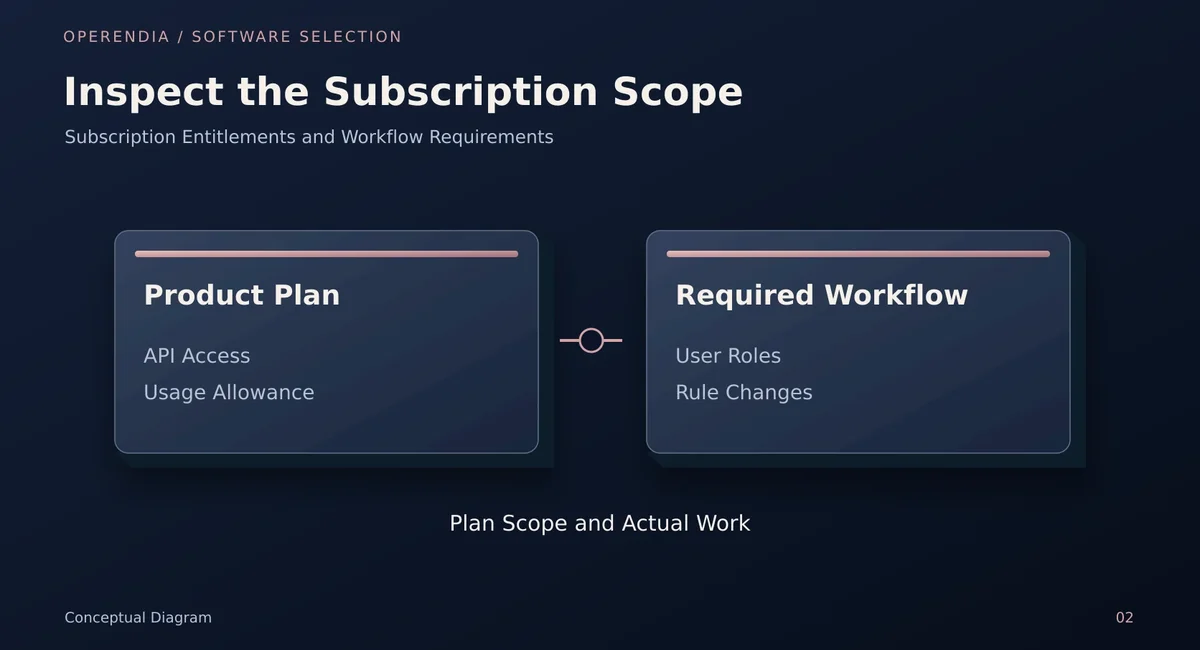
Inspect the Subscription's Boundaries
Subscription plans establish commercial boundaries for the application, so the appropriate price reflects the required access level and expected usage across the business. Some products reserve API access for a particular tier. For a company that must synchronize orders with another application, that entitlement belongs in the operating requirement. External-user access or an additional connector may carry a separate charge through the vendor's current agreement.
Custom extensions introduce a second maintenance relationship when they depend on an application's internal behavior or a vendor's versioned integration interfaces. After a product update, an extension may require a corresponding code revision. Supported extension points usually provide a documented contract for developers to follow; deeper modifications create additional upgrade dependencies. The product's general support agreement and the extension's maintenance agreement need separate consideration.
Commission Custom Software Around Business Rules
Custom development earns its place when an essential commercial requirement needs application behavior that would otherwise depend on repeated manual intervention or an awkward product workaround. Inside a multi-role marketplace, suppliers submit bids against events whose owners approve the selected offer. Administrator authority extends to separate actions. The permission model links an account's role to the specific event or bid it may change.
Specify the Difficult Transaction
The reservation application's design must account for competing requests when several customers attempt to purchase the same remaining item during an overlapping interval. Within a database transaction, row-level locks can serialize competing changes to the same inventory record. Once payment begins, the system needs an agreed reservation lifetime and a route for expired holds. The development scope includes those state changes and the visible checkout screens.
Employee tools require their own application design, since staff corrections must respect the same commercial rules that govern customer transactions on the public interface. In an administrative action, a permitted employee changes a reservation's state. The system records the employee's identity and the resulting change for later review. Even a compact website may require substantial backend work when its transactions have complex correction paths.
How Integrations Affect Software Fit
Integration feasibility depends on the records an API exposes and the actions it permits, with an explicit owner required to maintain the authoritative transaction state. If the booking application owns availability, a connected website needs a reliable route to its current inventory. Copies introduce synchronization work and a decision concerning acceptable delay. Separate identifiers must preserve the relationship between the original reservation and its counterpart in the connected application.
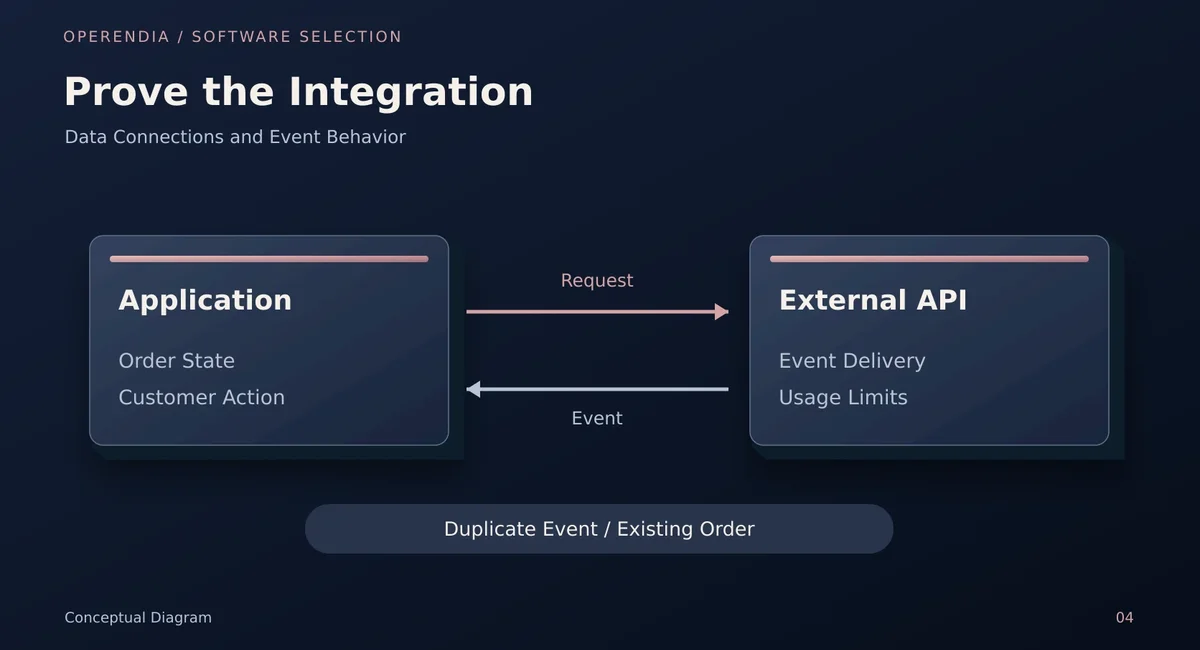
API capacity affects integration design when imports or traffic peaks generate concentrated requests against the same account during a short period. In Shopify's API documentation, limits vary by API, with plan-dependent allowances for select interfaces. Queues spread work across the permitted capacity. For a stock update needed at checkout, the resulting delay belongs in the architecture assessment and the acceptance test.
Account for Repeated Events
Payment integrations require explicit handling of repeated deliveries, since an application may receive a second notification about an event it has already processed. In Stripe's webhook guidance, duplicate events and variable event order require explicit treatment in the integration. Stored event identifiers support duplicate detection. For a useful acceptance test, repeat a payment notification and verify that the order retains the intended state.
Budget for the Application After Launch
The ownership comparison requires an agreed-upon period and an equivalent operating scope, with the SaaS proposal and the custom estimate each identifying the work required after release. For SaaS, include configuration support alongside the subscription. Custom estimates need funded maintenance and cloud expenditure. Data migration belongs in both proposals wherever existing records must move, and staff training requires an allowance for the employees involved.
Support terms warrant discussion in operational terms, especially when customers rely on the application in the evenings or during a concentrated seasonal sales period. If a reservation fails at an event entrance, who receives the incident and who can release a correction? The proposed support arrangement needs an answer tied to the operating hours. Response time and repair time describe different promises, so evaluate the provider's wording against the business's actual tolerance for interruption.
Code Access and Data Portability
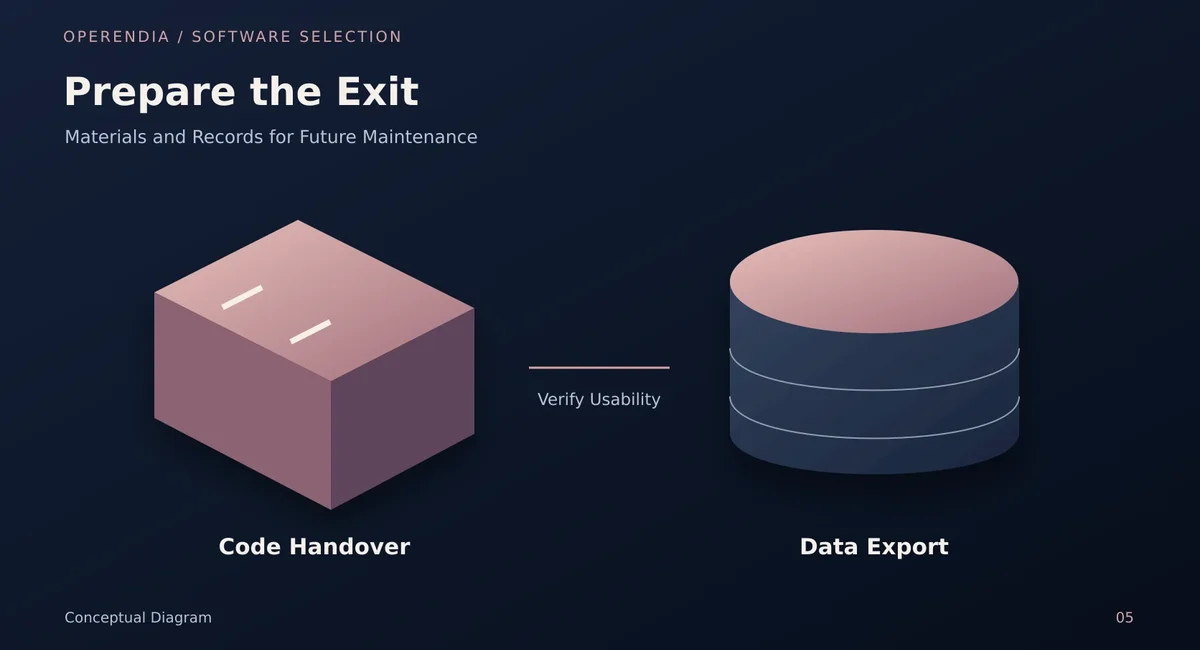
Ownership requires usable access to the materials needed for maintenance, so the handover agreement should be included in the software decision from the first commercial discussion. Repository access covers the code; a replacement team still needs deployment instructions that reproduce the application in an approved environment. Dependency licenses govern how included packages may be used. Future maintenance rests on the contractual rights and the technical materials available to the next qualified developer.
Data portability requires a working export that preserves the relationships needed by the replacement system, such as the connection between an order and its customer. Flat files often separate related records across exports. In a migration, identifiers allow the receiving application to reconstruct those relationships. Attachments may require a separate transfer procedure, and historical activity may have a different retention period than current operational records. Test an actual export against the intended destination.
Choose the Smallest Custom Scope That Fits
Many business systems suit a hybrid arrangement in which a purchased application handles familiar operations and custom software supplies the commercially specific workflow through an API. For example, an existing commerce platform may retain catalog administration while a custom customer portal applies an agreed access rule. Draw the boundary around the rule and name the system that owns each affected record.
The final selection should follow demonstrated workflow fit and an achievable support arrangement, with unresolved technical dependencies attached to the procurement decision as explicit conditions. If SaaS completes the required transaction through supported configuration, evaluate its contract and export route. Where the essential rule needs custom engineering, commission that behavior with acceptance tests. OPERENDIA's backend development work covers business APIs and application maintenance; the useful project brief starts with the transaction your company needs to complete.
 Make your brand matter.